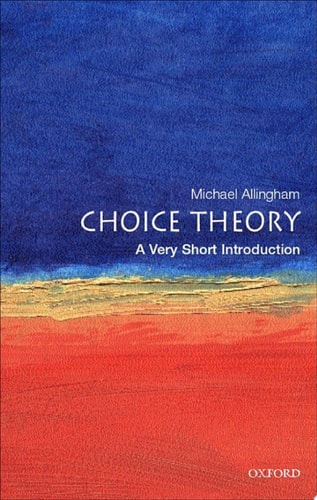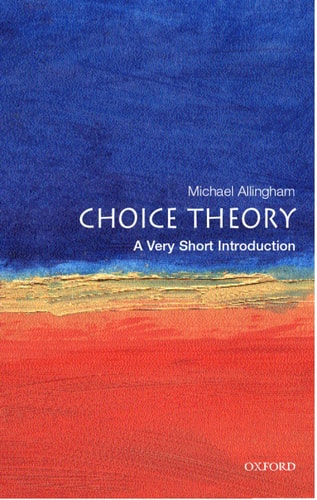
Choice Theory: A Very Short Introduction
0
0
As an Amazon Associate and affiliate partner, Menrva Books earns from qualifying purchases. Learn more
Author Description
We make choices all the time--about how to spend our money, about how to spend our time, about what to do with our lives. And we are also constantly judging the decisions other people make as rational or irrational. But what kind of criteria are we applying when we say that a choice is rational? What guides our own choices, especially in cases where we don't have complete information about the outcomes? What strategies should be applied in making decisions which affect a lot of people, as in the case of government policy?This book explores what it means to be rational in all these contexts. It introduces ideas from economics, philosophy, and other areas, showing how the theory applies to decisions in everyday life, and to particular situations such as gambling and the allocation of resources.
Menrva's Summary
THE THESIS
This book investigates the fundamental criteria used to define rational choice and how these principles apply to individual and collective decision-making. Michael Allingham, a noted economist and philosopher, utilizes a multidisciplinary framework to examine the logic behind human behavior. By synthesizing concepts from economics and philosophy, the author provides a structured approach to understanding how individuals navigate uncertainty and resource allocation in both personal and public spheres.
THE SCOPE MAP
What You Will Find
- Theoretical foundations of rational choice and decision-making
- Analysis of decision-making under conditions of incomplete information
- Applications of choice theory to gambling and resource allocation
- Examination of rational criteria in government policy
Scope Limits
- Does not provide an exhaustive mathematical treatment of advanced game theory
- Focuses on introductory conceptual frameworks rather than empirical data analysis
THE AUTHORITY PERSPECTIVE
Experts and readers frequently identify this work as a concise, accessible entry point for those unfamiliar with the complexities of decision theory. The text is noted for its ability to distill dense philosophical and economic arguments into a format suitable for a general audience.
Page Count:
144
Publication Date:
2002-11-28
Publisher:
Oxford University Press
ISBN-10:
0192803034
ISBN-13:
9780192803030
Philosophy
Economics
Social Science
Rationality
Decision Theory