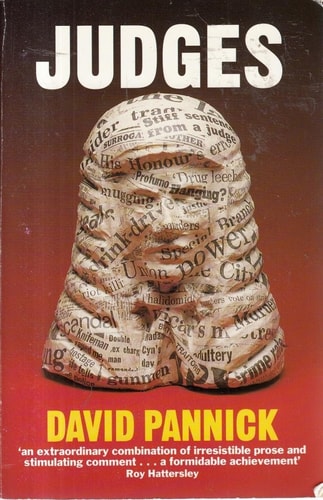
Judges
0
0
As an Amazon Associate and affiliate partner, Menrva Books earns from qualifying purchases. Learn more
Author Description
Supreme Court Justice Felix Frankfurter once observed that the ideal judge must possess three qualities--all of which are disinterestedness. But as David Pannick points out in this irreverent, informative, and highly entertaining volume, not all judges live up to Justice Frankfurter's standard. One American judge, when asked by a lawyer of Japanese descent for more time to prepare a case, shot back, "How much time did you give us at Pearl Harbor?" Others go to the opposite extreme, uninterestedness, and fall asleep during the trial, or knit, or read the paper. One English judge fell asleep so often that barristers would drop huge law books to the floor to wake him up again.Full of such illustrative examples and anecdotes, Judges offers a revealing portrait of the judicial systems of America and England. It is a vastly amusing book, but it has a serious purpose--to make us think more critically about officials whom we elect for life, who have the power to strike down laws, and whose mistakes, even if later reversed, can have a devastating impact on the people involved. How are judges selected? Is it wise to select supposedly impartial judges from the ranks of lawyers, who spend their careers in highly partisan and heated argument for one side of an issue? Should a judge who has spent his entire career in corporate law be allowed to hear cases in criminal court, as sometimes happens? (One English judge, appointed to the bench after a successful career in libel practice, claimed it was "fun trying Chancery matters of which I had no experience at all"--but how the litigants felt is another matter.) How are judges disciplined when they misbehave? And what changes are needed in this important but hitherto neglected area of government?Judges have a weighty responsibility; they repeatedly do what most of us seek to make decisions. These decisions can have serious a man may go to prison, a women may lose her house or the custody of her children, or an entire segment of the p
Menrva's Summary
THE THESIS
This book investigates the inherent contradictions and human failings within the judicial systems of the United States and England to determine if the current methods of selecting and disciplining judges are adequate. David Pannick, a prominent legal scholar and barrister, utilizes a collection of historical anecdotes and comparative legal analysis to challenge the assumption of judicial impartiality. He argues that the process of appointing judges from the ranks of partisan lawyers creates systemic risks that warrant greater public scrutiny and reform.
THE SCOPE MAP
What You Will Find
- Comparative analysis of American and English judicial appointment processes
- Historical anecdotes regarding judicial misconduct and incompetence
- Examination of the professional backgrounds of judges and their impact on case outcomes
- Discussion on mechanisms for judicial discipline and accountability
Scope Limits
- The text does not provide a comprehensive manual for legal reform or legislative drafting
- It focuses primarily on the English and American systems, excluding broader international judicial models
THE AUTHORITY PERSPECTIVE
Legal scholars and critics frequently note that the text balances academic inquiry with accessible, often humorous, storytelling. Experts highlight this as a useful introductory critique for those interested in the intersection of legal theory and the practical realities of the courtroom.
Page Count:
262
Publication Date:
1989-01-01
Publisher:
Oxford Paperbacks
ISBN-10:
0192822365
ISBN-13:
9780192822369
Biography
Non-Fiction
Politics
Judicial System
Legal Studies
Law
Subjects
Community Tags
Similar Books