Faust: Part Two
0
0
As an Amazon Associate and affiliate partner, Menrva Books earns from qualifying purchases. Learn more
Author Description
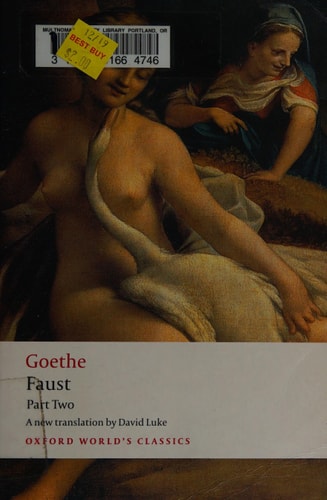
This is a new translation of Faust, Part Two by David Luke, whose translation of Faust, Part I was the winner of the European Poetry Translation Prize. Here, Luke expertly imitates the varied verse-forms of the original, and provides a highly readable and actable translation which includes an introduction, full notes, and an index of classical mythology.
Menrva's Summary
THE PULSE
Following his pact with Mephistopheles, Faust enters the complex, allegorical world of the imperial court and classical antiquity to seek ultimate fulfillment. Faust and his demonic companion navigate a series of expansive, dreamlike episodes that shift from political intrigue to the reconstruction of Greek myth. The protagonist seeks to transcend human limitations through power, aesthetic beauty, and grand engineering projects, while Mephistopheles acts as both facilitator and cynical observer. The narrative framework is highly stylized, utilizing shifting verse forms and dense symbolic imagery to represent the evolution of the human spirit. The world is governed by a blend of medieval folklore and classical Hellenistic tradition, creating a surreal environment where time and reality are fluid.
INSIDE THE PAGES
- Complex allegorical structure
- Varied verse forms and rhythmic structures
- Integration of Greek and Roman mythological figures
- Exploration of political and social power dynamics
- Philosophical inquiry into human ambition
- Surreal and dreamlike scene transitions
- Satirical commentary on contemporary society
- Extensive use of symbolism and metaphor
THE COLLECTIVE ECHO
Discussion often centers on the stark contrast between the grounded, personal narrative of the first part and the expansive, abstract nature of this sequel. Readers frequently highlight the technical difficulty of the text, noting that the dense mythological references require significant contextual knowledge to fully interpret. Critics often debate the effectiveness of the work's shifting tone, which moves rapidly between high-minded philosophical discourse and biting social satire. The work is widely regarded as a challenging but rewarding exploration of the limits of human achievement and the nature of redemption. Many readers emphasize that the play functions more as a symbolic poem than a traditional dramatic narrative, requiring a patient approach to its intricate structure.
Page Count:
400
Publication Date:
1999-07-22
Publisher:
Oxford University Press
ISBN-10:
0192836366
ISBN-13:
9780192836366
Drama
Poetry
Philosophy
Dramatic works
Mythology
classic
German