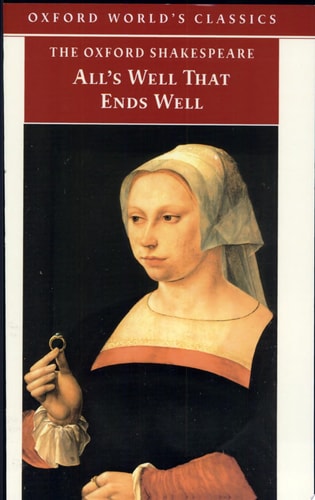
All's Well That Ends Well
0
0
As an Amazon Associate and affiliate partner, Menrva Books earns from qualifying purchases. Learn more
Author Description
Usually classified as a "problem comedy," All's Well that Ends Well is a psychologically disturbing presentation of an aggressive, designing woman and a reluctant husband wooed by trickery. In her introduction Susan Snyder makes the play's clashing ideologies of class and gender newly accessible, and offers a fully reconsidered, annotated text for both readers and actors.
Menrva's Summary
THE PULSE
Helena, a physician's daughter, pursues the aristocratic Bertram through deception and social maneuvering to secure a marriage he actively rejects. Driven by an intense, singular devotion, Helena utilizes her inherited medical knowledge to cure the King of France, subsequently demanding Bertram's hand as her reward. The narrative framework follows a traditional five-act play structure, presenting a stark conflict between Helena's pragmatic agency and Bertram's rigid adherence to class-based pride. The world operates under the strict social hierarchies of the Renaissance, where gender roles and noble lineage dictate the boundaries of personal autonomy.
INSIDE THE PAGES
- Exploration of the 'problem comedy' genre classification
- Examination of gender dynamics and female agency
- Conflict between meritocracy and hereditary nobility
- Use of bed-trick plot device to resolve marital tension
- Complex characterization of a reluctant, immature protagonist
- Analysis of social class and power imbalances
- Integration of medical lore and courtly intrigue
- Critical commentary on the nature of romantic pursuit
THE COLLECTIVE ECHO
Discussion often centers on the polarizing nature of the protagonist's actions and the ambiguous resolution of the marriage. Readers frequently highlight the play's tonal shifts, which oscillate between cynical realism and traditional comedic artifice. Critics often examine the psychological depth of the characters, noting that the work challenges conventional expectations of the romantic comedy genre. The play remains a subject of debate regarding its moral implications and the validity of its titular conclusion. Scholars and audiences alike continue to analyze how the text functions as a critique of aristocratic entitlement and gendered social structures.
Page Count:
256
Publication Date:
1998-10-29
Publisher:
Oxford University Press
ISBN-10:
0192836048
ISBN-13:
9780192836045
Drama
Comedy
Dramatic works
classic
Plays
Renaissance Theater
Community Tags
Other Editions(4)

Similar Books