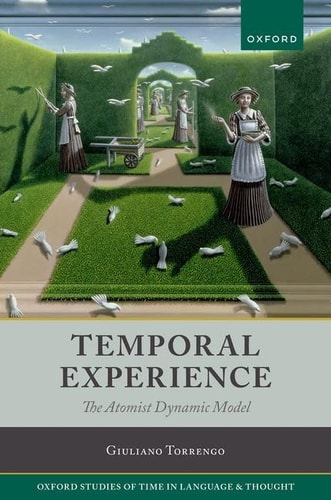
Temporal Experience: The Atomist Dynamic Model
0
0
As an Amazon Associate and affiliate partner, Menrva Books earns from qualifying purchases. Learn more
Author Description
Many physical theories suggest that time does not pass, yet temporality deeply permeates our experience. We perceive change and movement, we are aware of living in the present, of the constant flux of our sensations and thoughts, and of time itself flowing. In Temporal Experience, Torrengo considers the core facts of temporal experience and their interconnections, ultimately defending the atomist dynamic model of temporal experience.The book critically examines prevalent theories of experience of change, succession, and passage of time both in philosophy and psychology. Each chapter contributes to the construction of the atomist dynamic model. Experience of change and movement are explained through mental events that present virtually instantaneous movement and change. Torrengo challenges the common belief in the perception of 'presentness' and proposes an error theory based on narrative cognition. The experience of succession is elucidated through the concept of an overarching phenomenology, arguing against the tendency to overstate the phenomenal continuity of experience. Finally, the experience of the passage of time is approached through the non-representationalist theory of the phenomenal modifier, and the book concludes by discussing the surprising consequences of applying the experiential model defended to the scientific image of our existence in time as a sequence of physical events.
Menrva's Summary
THE THESIS
How can the human perception of time as a flowing, dynamic experience be reconciled with physical theories that suggest time is static? Prof. Giuliano Torrengo, a specialist in the philosophy of time, synthesizes insights from both psychology and analytic philosophy to construct the atomist dynamic model. He argues that our sense of change and succession arises from specific mental events rather than a continuous phenomenal stream, ultimately proposing an error theory regarding the perception of presentness.
THE SCOPE MAP
What You Will Find
- An analysis of the atomist dynamic model of temporal experience.
- A critique of representationalist theories concerning the passage of time.
- An investigation into the role of narrative cognition in shaping temporal awareness.
- A discussion on the intersection between phenomenal experience and the scientific image of physical events.
Scope Limits
- The text does not provide a comprehensive history of all temporal theories in physics.
- The work focuses primarily on the philosophical and cognitive aspects of experience rather than empirical neuroscientific data.
THE AUTHORITY PERSPECTIVE
Scholars in the field of philosophy of time recognize this work as a rigorous contribution to the debate on temporal phenomenology. Readers frequently note the academic density of the prose, which requires a strong background in analytic philosophy to fully grasp the proposed model.
Page Count:
272
Publication Date:
2024-11-18
Publisher:
Oxford University Press
ISBN-10:
0192845586
ISBN-13:
9780192845580
Politics
Philosophy
Semantics
Linguistics
Words Language & Grammar
Philosophy of
Metaphysics
Time Perception
Reference
Community Tags
Similar Books