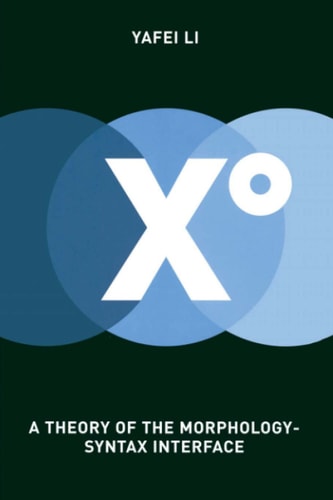
X0: A Theory of the Morphology-Syntax Interface
0
0
As an Amazon Associate and affiliate partner, Menrva Books earns from qualifying purchases. Learn more
Author Description
This important monograph offers a resolution to the debate in theoretical linguistics over the role of syntactic head movement in word formation. It does so by synthesizing the syntactic and lexicalist approaches on the basis of the empirical data that support each side. In trying to determine how a morphologically complex word is formed in Universal Grammar, generative linguists have argued either that a substantial amount of morphological phenomena result from head movement in overt syntax (the widely adopted syntactic approach) or that morphological/lexical means are both necessary and sufficient for a theory of word formation (the Lexicalist Hypothesis). Li examines both the linguistic facts that are brought to light for the first time and the existing data in the literature and shows that each side has an empirical foundation that cannot be negated by the other. Since neither approach is adequate to explain all the facts of word formation, he argues, the way to achieve a unified account lies in synthesizing the empirically advantageous portions of both approaches into one simple and coherent theory.Li begins by demonstrating how a theory that combines the essence of the syntactic and lexicalist approaches can account more accurately for the various morphological constructions analyzed in the literature by means of syntactic verb incorporation. He then examines causativization on the adjectival root, noun incorporation in polysynthetic languages, and the possibility that the word formation part of the Lexicalist Hypothesis -- which is crucial to his theory -- can be derived as a theorem from a version of the X-bar theory. He concludes by discussing methodological issues in current linguistic research.
Menrva's Summary
THE THESIS
This monograph addresses the fundamental debate in theoretical linguistics concerning the role of syntactic head movement versus lexicalist approaches in word formation. The author, Yafei Li, synthesizes these two dominant perspectives by examining empirical data from both sides to propose a unified theory of Universal Grammar for morphologically complex words. Li argues that neither the purely syntactic approach, which posits head movement in overt syntax, nor the Lexicalist Hypothesis, which asserts the sufficiency of morphological means, can fully explain all word formation facts. Therefore, a comprehensive account requires integrating the strengths of both.
THE SCOPE MAP
- An examination of syntactic verb incorporation to account for various morphological constructions.
- Analysis of causativization on adjectival roots.
- Discussion of noun incorporation in polysynthetic languages.
- Exploration of deriving the word formation component of the Lexicalist Hypothesis from X-bar theory.
- Consideration of methodological issues in current linguistic research.
THE AUTHORITY PERSPECTIVE
This work is regarded as an important monograph within theoretical linguistics for its attempt to resolve the long-standing debate between syntactic and lexicalist approaches to word formation. By synthesizing empirical data from both sides, the author proposes a unified theory that accounts for phenomena previously explained by either perspective alone. The book's detailed analysis of specific constructions like verb incorporation and causativization, alongside its theoretical arguments, positions it as a significant contribution to understanding the morphology-syntax interface. It is likely to be of interest to specialists in generative grammar and morphology.
Page Count:
222
Publication Date:
2005-01-01
Publisher:
MIT Press
ISBN-10:
0262621916
ISBN-13:
9780262621915
Science
Non-Fiction
Syntax
Theoretical Linguistics
Linguistics
Morphology
Community Tags
Similar Books