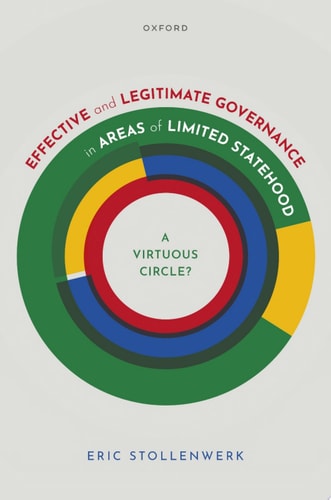
Effective and Legitimate Governance in Areas of Limited Statehood: A Virtuous Circle?
0
0
As an Amazon Associate and affiliate partner, Menrva Books earns from qualifying purchases. Learn more
Author Description
How can effective and legitimate governance be ensured where state institutions are weak? This is a key question for domestic and international politics. One answer to this question that has received considerable attention in political science, but also among development agencies and international organizations, is virtuous circles of governance. In such circles, effective and legitimate governance are thought to be mutually reinforcing. The idea is that more effective governance leads to more legitimacy and more legitimacy to more effectiveness in governance. In many parts of the world, however, state institutions are weak and citizens perceive governance as ineffective and governance actors lack legitimacy. This places a large question mark behind the idea of virtuous circles of governance. Effective and Legitimate Governance in Areas of Limited Statehood asks: How likely are virtuous circles of governance to evolve in areas of limited statehood? The central claim of this book is that virtuous circles of governance are possible in areas of limited statehood, but more likely to evolve for external and non-state actors than for the state. The state is often part of the governance problem rather than the solution. Based on a new theoretical model for the interplay between effective and legitimate governance, the study provides in-depth empirical evidence for its argument by drawing on innovative qualitative and quantitative data. The case studies of Sub-Saharan Africa, Nigeria, and Afghanistan underline the key argument by considering state, external, and non-state actors. The book offers conceptual innovations, new empirical evidence, and policy recommendations of how to ensure effective and legitimate governance in areas of limited statehood.
Menrva's Summary
THE THESIS
This book investigates whether virtuous circles of governance, where effectiveness and legitimacy mutually reinforce one another, can realistically evolve in regions characterized by limited statehood. Eric Stollenwerk utilizes his expertise in political science to challenge the assumption that state institutions are the primary drivers of stability. By developing a new theoretical model, the author argues that non-state and external actors are more likely to foster these virtuous circles than the state itself, which often functions as a source of instability.
THE SCOPE MAP
What You Will Find
- A theoretical framework analyzing the interplay between governance effectiveness and legitimacy.
- Comparative case studies focusing on Sub-Saharan Africa, Nigeria, and Afghanistan.
- A synthesis of both qualitative and quantitative empirical data.
Scope Limits
- The analysis does not provide a universal blueprint for state-building in all post-conflict zones.
- The research focuses primarily on the limitations of state actors rather than the long-term sustainability of non-state governance structures.
THE AUTHORITY PERSPECTIVE
Experts in international development and political science recognize this work as a significant contribution to the study of governance in fragile states. The text is noted for its rigorous empirical approach and its critical re-evaluation of traditional state-centric development models.
Page Count:
288
Publication Date:
2022-01-01
Publisher:
Oxford University Press
ISBN-10:
0192858920
ISBN-13:
9780192858924
Governance
International relations
Public Policy
Community Tags
Similar Books