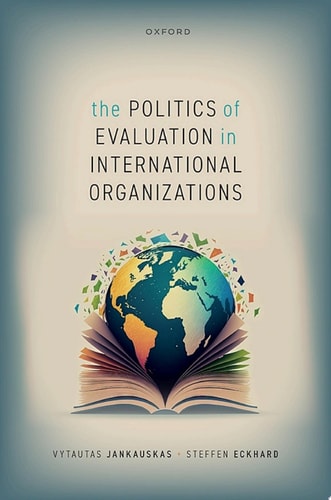
The Politics of Evaluation in International Organizations
0
0
As an Amazon Associate and affiliate partner, Menrva Books earns from qualifying purchases. Learn more
Author Description
Evaluation has become a key tool in assessing the performance of international organizations, in fostering learning, and in demonstrating accountability. Within the United Nations (UN) system, thousands of evaluators and consultants produce hundreds of evaluation reports worth millions of dollars every year. But does evaluation really deliver on its promise of objective evidence and functional use? By unravelling the internal machinery of evaluation systems in international organizations, this book challenges the conventional understanding of evaluation as a value-free activity. Vytautas Jankauskas and Steffen Eckhard show how a seemingly neutral technocratic tool can serve as an instrument for power in global governance; they demonstrate and explain how deeply politics are entrenched in the interests of evaluation stakeholders, in the control and design of IO evaluation systems, and to a lesser extent also in the content of evaluation reports. The analysis draws on 120 research interviews with evaluators, member state representatives, and IO secretariat officials as well as on textual analysis of over 200 evaluation reports. The investigation covers 21 UN system organizations, including detailed case studies of the ILO, IMF, UNDP, UN WOMEN, IOM, UNHCR, FAO, WHO, and UNESCO. Shedding light on the (in-)effectiveness of evidence-based policymaking, the authors propose possible ways of better reconciling the observed evaluation politics with the need to gather reliable evidence that is used to improve the functioning of the United Nations. The answer to evaluation politics is not to abandon evaluation or isolate it from the stakeholders but to acknowledge surrounding political interests and design evaluation systems accordingly.
Menrva's Summary
THE THESIS
This book investigates whether the evaluation systems within international organizations function as objective, evidence-based tools or as instruments of political power. Steffen Eckhard and Vytautas Jankauskas, both scholars in international relations and public administration, utilize a combination of qualitative interviews and quantitative textual analysis to examine the internal mechanics of the United Nations system. They argue that evaluation is inherently political, shaped by the competing interests of stakeholders, and propose structural reforms to better align these systems with the goal of reliable evidence-based policymaking.
THE SCOPE MAP
What You Will Find
- Analysis of 21 United Nations system organizations, including the ILO, IMF, UNDP, and WHO.
- A dataset derived from 120 semi-structured interviews with evaluators, member state representatives, and secretariat officials.
- A systematic textual analysis of over 200 evaluation reports.
- A framework for understanding the intersection of technocratic evaluation and global governance power dynamics.
Scope Limits
- The study focuses primarily on the United Nations system and may not fully generalize to non-UN international organizations or private sector evaluation practices.
- The research does not provide a comprehensive audit of every individual evaluation report produced by the studied organizations.
THE AUTHORITY PERSPECTIVE
Experts in international organization studies view this work as a significant contribution to the literature on bureaucratic politics and administrative accountability. Readers frequently note the academic rigor of the methodology and the clarity with which the authors navigate the complex intersection of technocratic procedure and political influence.
Page Count:
347
Publication Date:
2023-01-01
Publisher:
OUP Oxford
ISBN-10:
0192667408
ISBN-13:
9780192667403
Governance
Public Policy
Organizational Theory
International relations
United Nations
Public Administration
Community Tags
Similar Books