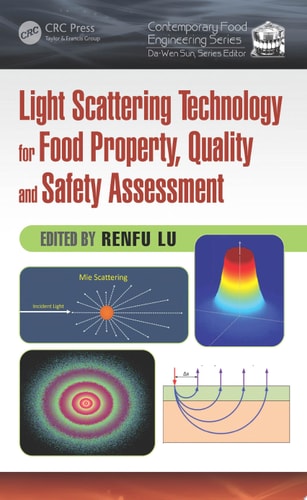
Light Scattering Technology for Food Property, Quality and Safety Assessment
0
0
As an Amazon Associate and affiliate partner, Menrva Books earns from qualifying purchases. Learn more
Author Description
Light Scattering Technology for Food Property, Quality and Safety Assessment discusses the development and application of various light scattering techniques for measuring the structural and rheological properties of food, evaluating composition and quality attributes, and detecting pathogens in food. The first four chapters cover basic concepts, principles, theories, and modeling of light transfer in food and biological materials. Chapters 5 and 6 describe parameter estimation methods and basic techniques for determining optical absorption and scattering properties of food products. Chapter 7 discusses the spatially-resolved measurement technique for determining the optical properties of food and biological materials, whereas Chapter 8 focuses on the time-resolved spectroscopic technique for measuring optical properties and quality or maturity of horticultural products. Chapter 9 examines practical light scattering techniques for nondestructive quality assessment of fruits and vegetables. Chapter 10 presents the theory of light transfer in meat muscle and the measurement of optical properties for determining the postmortem condition and textural properties of muscle foods and meat analogs. Chapter 11 covers the applications of spatially-resolved light scattering techniques for assessing quality and safety of animal products. Chapter 12 looks into light scattering for milk and dairy processing. Chapter 13 examines the applications of dynamic light scattering for measuring the microstructure and rheological properties of food. Chapter 14 shows the applications of a biospeckle technique for assessing the quality and condition of fruits and vegetables. Chapter 15 provides a detailed description of Raman scattering spectroscopic and imaging techniques in food quality and safety assessment. Chapter 16, the final chapter, focuses on applications of light scattering techniques for the detection of food-borne pathogens.
Menrva's Summary
THE THESIS
This book explores the multifaceted applications of light scattering technology in the food industry. It details how various light scattering techniques can be employed to measure structural and rheological properties, assess composition and quality attributes, and detect pathogens. The text systematically covers fundamental principles, parameter estimation, and specific measurement techniques, progressing through applications in diverse food products like fruits, vegetables, meat, milk, and dairy.
THE SCOPE MAP
- Fundamentals, principles, theories, and modeling of light transfer in food and biological materials.
- Methods for determining optical absorption and scattering properties of food products.
- Spatially-resolved and time-resolved spectroscopic techniques for optical properties and quality assessment.
- Nondestructive quality assessment of fruits and vegetables using light scattering.
- Application of light scattering for determining postmortem condition and textural properties of muscle foods.
- Light scattering applications in milk and dairy processing.
- Dynamic light scattering for measuring microstructure and rheological properties.
- Biospeckle technique for assessing fruit and vegetable quality and condition.
- Raman scattering spectroscopic and imaging techniques for food quality and safety.
- Light scattering for the detection of food-borne pathogens.
THE AUTHORITY PERSPECTIVE
The book is structured as a comprehensive technical reference, likely appealing to researchers, food scientists, and industry professionals involved in food analysis. Its detailed chapter breakdown suggests a thorough exploration of specific methodologies and their practical implementations across various food categories. The focus on both fundamental principles and applied techniques indicates a resource designed for in-depth study and problem-solving in food property, quality, and safety assessment.
Page Count:
483
Publication Date:
2017-11-22
Publisher:
Taylor & Francis
ISBN-10:
1482263351
ISBN-13:
9781482263350
Science & Technology
Non-Fiction
Science
Technology
Food Science
Quality Control
Measurement
Community Tags
Other Editions(3)

Similar Books











Reader Comments
Share Your Thoughts
No comments yet. Be the first to share your thoughts!