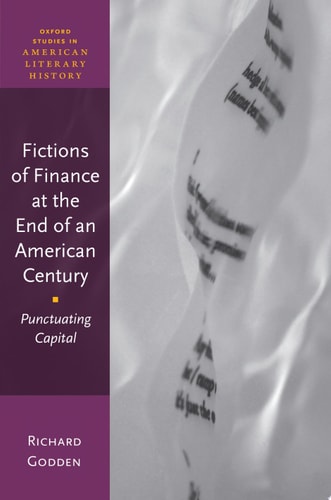
Fictions of Finance at the End of an American Century: Punctuating Capital
0
0
As an Amazon Associate and affiliate partner, Menrva Books earns from qualifying purchases. Learn more
Author Description
Fictions of Finance at the End of an American Century explores how an economy determines the language of those who live among its imperatives--and how it makes available to them the stories that they can and cannot tell, and the manner of their telling. Read closely, fictional narrative may expose the historical structures that determine literary language use, and that of language more generally. The study, the fourth in a quartet of studies addressing the emergence and decline of a Fordist regime of capitalist accumulation, offers an account of 'the sub-semantic whispering' that haunts the literature of the financial turn--which is to say, an account of how the complexities of words and their histories register an expanding industrial economy's organizing contradictions and failures. Reading in the light of deindustrialization and the rise of US finance capital after 1973, it deploys and elaborates on a materialist theory of language that explains how syntactic as well as semantic structures register a financializing economy's core contradictions, those associated particularly with debt, risk, and volatility. The volume listens for the under-heard syntactical breaks that punctuate language under the global hegemony of finance, breaks that express the unuttered in all utterance, taking as its exemplary texts primarily works by Bret Easton Ellis, Jayne Anne Phillips, and David Foster Wallace.
Menrva's Summary
THE THESIS
This study investigates how the transition to a finance-dominated economy in the United States after 1973 fundamentally altered the linguistic structures and narrative possibilities available to contemporary authors. Professor Richard Godden, an expert in American literary history, utilizes a materialist theory of language to analyze how syntactic and semantic patterns in literature reflect the contradictions of debt, risk, and volatility inherent in late-stage capitalism. By examining the works of authors such as Bret Easton Ellis, Jayne Anne Phillips, and David Foster Wallace, the text argues that literary language acts as a register for the systemic failures and organizing tensions of a deindustrializing nation.
THE SCOPE MAP
What You Will Find
- Analysis of the shift from Fordist industrial accumulation to US finance capital.
- A materialist framework for interpreting syntactic breaks and sub-semantic patterns in prose.
- Close readings of key literary texts from the late 20th century.
Scope Limits
- The study focuses primarily on the American literary context and does not provide a comprehensive global economic history.
- It does not offer prescriptive economic policy solutions, remaining strictly within the realm of literary and cultural analysis.
THE AUTHORITY PERSPECTIVE
Scholars and critics recognize this work as a dense, theoretically rigorous contribution to the field of American literary history. Readers frequently note the academic complexity of the prose, which is intended for those familiar with materialist theory and the socio-economic history of the late 20th century.
Page Count:
288
Publication Date:
2023-01-01
Publisher:
Oxford University Press
ISBN-10:
019286775X
ISBN-13:
9780192867759
Economics
American
Marxist Theory
Finance
Literary Criticism
Community Tags
Other Editions(2)
Similar Books