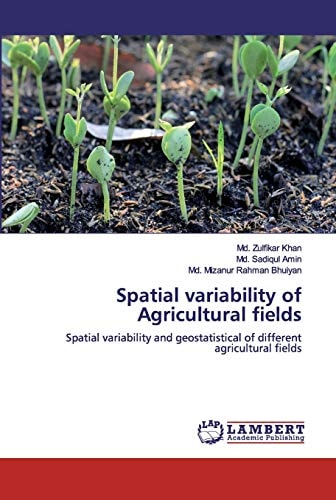
Spatial Variability of Agricultural Fields: Spatial Variability and Geostatistical Analysis of Different Agricultural Fields
0
0
As an Amazon Associate and affiliate partner, Menrva Books earns from qualifying purchases. Learn more
Author Description
Thus, descriptive statistics indicated the size able spatial variability for all soil variables. Further understanding of the spatial structures of soil variables can be helpful for revealing their spatial distribution and achieving the reasonable site specific farming management. The geo-statistical analysis of soil variables suggested that the value nugget-sill ratio ranges from 0% (EC) to 55.22% (Av P), except for available sulfur(72.21%), indicating that internal factors were dominant over external factors. Soil EC and OM had the strong spatial dependence with a nugget-sill ratio of < 25%, because it induced by structural factors. But the spatial variability of other soil variables (pH, TN, Av P, Av K & Av S) had the moderate spatial dependence with a nugget-sill ratio of 25-75%, because the variables were mainly determined by internal and external factors.These results are reflection of many factors including soil pH, CEC, OC, amount of moisture held by soil particles, fertilizer application, animal manure application with different amendments, intensive cropping system, different land use pattern, topography of the field at different weather condition and texture percentage.
Menrva's Summary
THE THESIS
This study investigates the spatial variability and geostatistical properties of various soil variables across different agricultural fields. The research utilizes descriptive statistics and geostatistical analysis to understand the spatial structures and distributions of soil properties such as EC, Av P, pH, TN, Av K, and Av S. By examining the nugget-sill ratio, the study aims to differentiate between internal and external factors influencing these variables, providing insights for site-specific farming management.
THE SCOPE MAP
- Analysis of spatial variability for soil variables including EC, Av P, pH, TN, Av K, and Av S.
- Application of geostatistical methods to understand spatial structures and distributions.
- Determination of the nugget-sill ratio to assess the dominance of internal versus external factors.
- Classification of spatial dependence (strong, moderate) based on the nugget-sill ratio.
- Identification of factors influencing spatial variability, such as soil pH, CEC, OC, moisture, fertilizer application, land use, topography, and texture.
- Implications for site-specific farming management and agricultural practices.
THE AUTHORITY PERSPECTIVE
The study presents a detailed geostatistical analysis of soil variables, highlighting significant spatial variability across agricultural fields. The findings suggest that internal soil factors are often dominant, particularly for EC and OM, which exhibit strong spatial dependence. Other variables like pH, TN, Av P, Av K, and Av S show moderate spatial dependence, influenced by a combination of internal and external factors. These results offer valuable insights for optimizing site-specific agricultural management strategies.
Page Count:
68
Publication Date:
2019-10-01
Publisher:
LAP LAMBERT Academic Publishing
ISBN-10:
620043865X
ISBN-13:
9786200438652
Non-Fiction
Science
Agriculture
Soil Science
Geostatistics
Community Tags
Similar Books