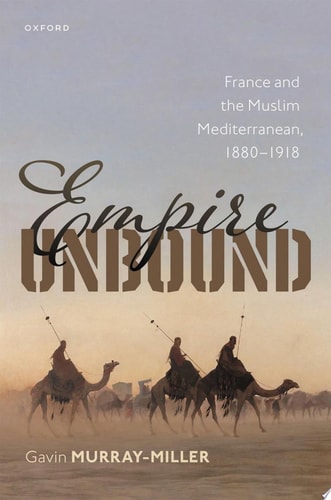
Empire Unbound: France and the Muslim Mediterranean, 1880-1918
0
0
As an Amazon Associate and affiliate partner, Menrva Books earns from qualifying purchases. Learn more
Author Description
European empires were commonly depicted in bright color-coded maps printed during the nineteenth and twentieth centuries that conveyed the expanse of European power across the globe. Despite this familiar image of a world divided up into neat imperial enclaves, the reality of empire-building often told a different story. Empire Unbound argues that European empires were never the bounded, stable entities that imperialists imagined. In examining Mediterranean empire-building in a comparative context, Gavin Murray-Miller demonstrates that the era of 'new imperialism' which arose in the late nineteenth century fostered connections and synergies between regional powers that influenced the trajectories of imperial states in fundamental ways. Breaking with conventional national approaches, Murray-Miller traces the development of France's North African empire, noting how empire-building relied upon transnational networks and cooperation with Muslims elites across borders just as much as military conquest. By looking at the inter-connected relationships linking the French, British, Italian, and Ottoman empires from the 1880s through the First World War, Empire Unbound proposes a novel spatial framework for imperial studies, showing how migrations, extraterritorial legal regimes, and cross-border interactions both abetted and frustrated imperial designs at the turn of the century.
Menrva's Summary
THE THESIS
This book investigates how the French empire in the Mediterranean functioned not as a static, bounded entity, but as a dynamic network shaped by transnational interactions and cross-border cooperation. Gavin Murray-Miller, a scholar of modern European and Mediterranean history, utilizes a comparative framework to challenge traditional national-centric narratives of imperialism. He argues that the expansion of French power in North Africa was fundamentally dependent on synergies with Muslim elites and regional powers, rather than solely on military force.
THE SCOPE MAP
What You Will Find
- Analysis of the French, British, Italian, and Ottoman imperial interactions from 1880 to 1918.
- Examination of transnational networks, migration patterns, and extraterritorial legal regimes.
- Case studies on the cooperation between colonial administrators and local Muslim elites.
Scope Limits
- The study focuses primarily on the Mediterranean basin and does not provide an exhaustive account of French colonial activities in sub-Saharan Africa or Southeast Asia.
THE AUTHORITY PERSPECTIVE
Historians and scholars of imperial studies recognize this work as a significant contribution to the spatial understanding of colonial history. Readers frequently note the academic density of the prose and the author's success in moving beyond conventional national-state historiography.
Page Count:
304
Publication Date:
2022-10-31
Publisher:
Oxford University Press
ISBN-10:
0192863118
ISBN-13:
9780192863119
Politics
History
European History
Kindle Store
Kindle eBooks
Middle Eastern
Colonialism
Categories
Imperialism
Community Tags
Similar Books