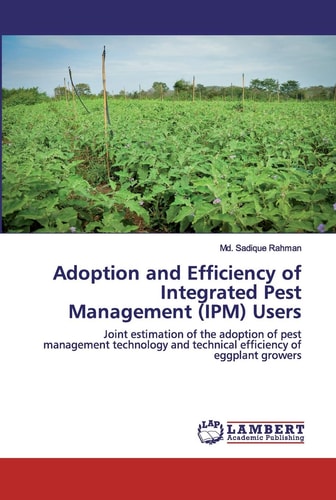
Adoption and Efficiency of Integrated Pest Management (IPM) Users: Joint estimation of the adoption of pest management technology and technical efficiency of eggplant growers
0
0
As an Amazon Associate and affiliate partner, Menrva Books earns from qualifying purchases. Learn more
Author Description
Pesticide overuse has several negative effects on soil, health, and environment. As a result, several Integrated Pest Management (IPM) technologies have been developed for use on vegetables and adopted by farmers. The present study compares the technical efficiency level of eggplant IPM adopters and non-adopters. A total of 283 farmers were interviewed in 2015. A stochastic frontier production function with sample selection approach was used to compare the technical efficiency of IPM adopters and non-adopters. Experience and training on IPM significantly influenced adoption of IPM. The mean technical efficiency of adopters is higher compared to non-adopters. The findings also indicate that due to selectivity bias the conventional model over estimates technical efficiency. Highest 32.65% and 30.41% of the adopters and non-adopters have technical efficiency scores ranging between 60 and 80%. Market accessibility negatively influenced technical inefficiency. The study concludes that in order to further improve effective Government policy and extension efforts are warranted.
Menrva's Summary
THE THESIS
This study investigates the adoption and efficiency of Integrated Pest Management (IPM) technologies among eggplant growers, addressing the critical issue of pesticide overuse. The research compares the technical efficiency of farmers who have adopted IPM with those who have not, utilizing data from 283 interviews conducted in 2015. A stochastic frontier production function with a sample selection approach was employed to analyze the technical efficiency, revealing that experience and training significantly influence IPM adoption. The findings demonstrate that IPM adopters exhibit higher mean technical efficiency than non-adopters, and highlight the overestimation of technical efficiency by conventional models due to selectivity bias.
THE SCOPE MAP
- Analysis of the adoption factors for Integrated Pest Management (IPM) technologies in eggplant cultivation.
- Comparative technical efficiency assessment between IPM adopters and non-adopters.
- Application of a stochastic frontier production function with a sample selection approach.
- Identification of key influences on IPM adoption, including experience and training.
- Quantification of technical efficiency scores for both adopter and non-adopter groups.
- Examination of market accessibility's impact on technical inefficiency.
- Policy recommendations for improving government and extension efforts in IPM promotion.
THE AUTHORITY PERSPECTIVE
This study provides a rigorous quantitative analysis of Integrated Pest Management (IPM) adoption and its impact on the technical efficiency of eggplant farmers. By employing a sophisticated econometric model, it addresses potential selectivity bias inherent in such comparisons, offering more accurate insights than conventional methods. The findings underscore the importance of farmer education and experience in driving sustainable agricultural practices and suggest targeted policy interventions to enhance efficiency and reduce pesticide reliance.
Page Count:
68
Publication Date:
2020-06-17
Publisher:
LAP LAMBERT Academic Publishing
ISBN-10:
6202671572
ISBN-13:
9786202671576
Science
Non-Fiction
Economics
Research
Agriculture
Community Tags
Similar Books














