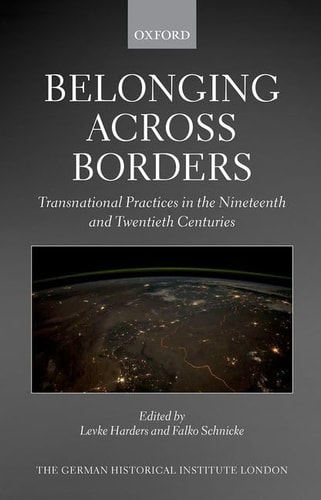
Belonging across Borders: Transnational Practices in the Nineteenth and Twentieth Centuries
0
0
As an Amazon Associate and affiliate partner, Menrva Books earns from qualifying purchases. Learn more
Author Description
Borders and belonging are of immense importance as borders are being (re)defined, strengthened, or weakened all around the globe. Brexit, the proposed wall between the USA and Mexico, the India-Pakistan border-the drawing of social and spatial boundaries is at the heart of many current debates, as is the question of what it means to 'belong' somewhere. Unlike the main body of literature, Belonging Across Borders argues that processes which occurred before and beyond the nation state also influence inclusion and exclusion. Focusing on practices and historical subjects, it re-evaluates historical sources and goes beyond the existing research to look at the interplay between different reference points (empire, nation, and region) and at individuals, exploring borders as both territorial and social boundaries. This approach is in line with recent calls to expand border studies by adding a historical perspective and using new methodologies and theories. Geographers and anthropologists have been studying this topic for decades and have produced a range of inspiring research. However, a more historical perspective is also needed: first, to emphasize the existence of different types of borders, bordering, and border actors through historical case studies; second, to underscore the historical specificity of border practices; and third, to highlight their dependence on historical contexts. Belonging Across Borders breaks new ground by applying the concept of belonging to historical studies on borders, empires, nations, and regions. It also links borders and belonging to individual historical actors and their practices, not just to institutions or social groups.
Menrva's Summary
THE THESIS
This volume investigates how historical processes occurring before and beyond the nation-state influence contemporary concepts of inclusion and exclusion. Editors Falko Schnicke and Levke Harders compile a series of historical case studies to argue that belonging is shaped by the interplay between empires, nations, and regions. By focusing on individual historical actors rather than just institutional frameworks, the contributors demonstrate how border practices are historically specific and context-dependent.
THE SCOPE MAP
What You Will Find
- Analysis of border practices across the nineteenth and twentieth centuries
- Theoretical frameworks integrating geography, anthropology, and history
- Case studies examining the intersection of territorial and social boundaries
Scope Limits
- Does not provide a comprehensive global history of all border conflicts
- Focuses primarily on historical methodologies rather than current political policy analysis
THE AUTHORITY PERSPECTIVE
Scholars in the field of border studies recognize this work as a significant contribution to the historical contextualization of migration and identity. Experts frequently note that the text provides a necessary bridge between social science theory and rigorous historical archival research.
Page Count:
360
Publication Date:
2023-01-01
Publisher:
Oxford University Press
ISBN-10:
0192867490
ISBN-13:
9780192867490
History
Border Studies
Sociology
European History
Community Tags
Similar Books