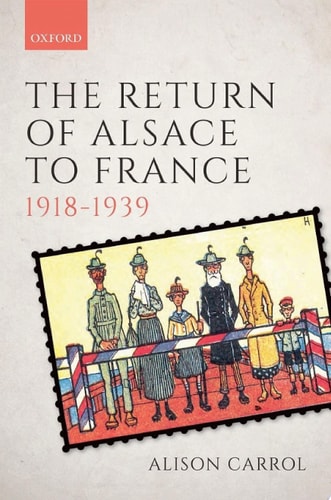
The Return of Alsace to France, 1918-1939
0
0
As an Amazon Associate and affiliate partner, Menrva Books earns from qualifying purchases. Learn more
Author Description
In 1918, the end of the First World War triggered the return of Alsace and Lorraine to France after almost fifty years of annexation into the German Empire. Enthusiastic crowds in Paris and Alsace celebrated the return of the 'lost provinces,' but return proved far more difficult than expected. Over the following two decades, politicians, administrators, industrialists, cultural elites, and others grappled with the question of how to make the region French again. Differences of opinion emerged, and reintegration rapidly descended into a multi-faceted struggle as voices at the Parisian centre, the Alsatian periphery, and outside France's borders offered their views on how to introduce French institutions and systems into its lost borderland. Throughout these discussions, the border itself shaped the process of reintegration, by generating contact and tensions between populations on the two sides of the boundary line, and by shaping expectations of what it meant to be French and Alsatian. Borderland is the first comprehensive account of the return of Alsace to France which treats the border as a driver of change. It draws upon national, regional, and local archives to follow the difficult process of Alsace's reintegration into French society, culture, political and economic systems, and legislative and administrative institutions. It connects the microhistory of the region with the 'macro' levels of national policy, international relations, and transnational networks, and with the cross-border flows of ideas, goods, people, and cultural products that shaped daily life in Alsace as its population grappled with the meaning of return to France. In revealing the multiple voices who contributed to the region's reintegration, it underlines the ways in which regional populations and cross-border interactions have forged modern nations.
Menrva's Summary
THE THESIS
This work investigates the complex socio-political challenges and administrative processes involved in the reintegration of Alsace into France following the conclusion of the First World War. Alison Carrol, a historian specializing in modern European history, utilizes a combination of national, regional, and local archival research to analyze the friction between Parisian centralism and Alsatian regional identity. The book argues that the border itself functioned as a primary driver of change, influencing the implementation of French institutions and the evolving definition of national belonging between 1918 and 1939.
THE SCOPE MAP
What You Will Find
- Analysis of the administrative and legislative integration of Alsace into the French state.
- Examination of cross-border flows of goods, people, and cultural ideas.
- Case studies on the perspectives of industrialists, cultural elites, and local administrators.
- Synthesis of micro-historical regional data with macro-level international relations.
Scope Limits
- The study is strictly confined to the period between 1918 and 1939.
- It does not provide an exhaustive military history of the region during the conflict itself.
THE AUTHORITY PERSPECTIVE
Scholars recognize this text as a significant contribution to borderland studies and the historiography of French regional identity. Readers frequently note the meticulous use of archival sources to bridge the gap between local experience and national policy.
Page Count:
229
Publication Date:
2018-01-01
Publisher:
OUP Oxford
ISBN-10:
0192525913
ISBN-13:
9780192525918
History
Political History
Alsace France
20th Century
French History
European History
Border Studies
Community Tags
Other Editions(3)
Similar Books










Reader Comments
Share Your Thoughts
No comments yet. Be the first to share your thoughts!