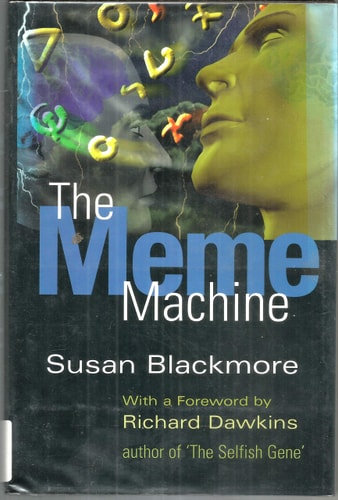
The Meme Machine
0
0
As an Amazon Associate and affiliate partner, Menrva Books earns from qualifying purchases. Learn more
Author Description
What is a meme? First coined by Richard Dawkins in The Selfish Gene, a meme is any idea, behavior, or skill that can be transferred from one person to another by imitation: stories, fashions, inventions, recipes, songs, ways of plowing a field or throwing a baseball or making a sculpture. The meme is also one of the most important--and controversial--concepts to emerge since The Origin of Species appeared nearly 150 years ago.In The Meme Machine Susan Blackmore boldly asserts: "Just as the design of our bodies can be understood only in terms of natural selection, so the design of our minds can be understood only in terms of memetic selection." Indeed, Blackmore shows that once our distant ancestors acquired the crucial ability to imitate, a second kind of natural selection began, a survival of the fittest amongst competing ideas and behaviors. Ideas and behaviors that proved most adaptive--making tools, for example, or using language--survived and flourished, replicating themselves in as many minds as possible. These memes then passed themselves on from generation to generation by helping to ensure that the genes of those who acquired them also survived and reproduced. Applying this theory to many aspects of human life, Blackmore offers brilliant explanations for why we live in cities, why we talk so much, why we can't stop thinking, why we behave altruistically, how we choose our mates, and much more.With controversial implications for our religious beliefs, our free will, our very sense of "self," The Meme Machine offers a provocative theory everyone will soon be talking about.
Menrva's Summary
THE THESIS
Does the concept of the meme provide a comprehensive framework for understanding the evolution of the human mind and culture? Susan Blackmore, a psychologist and writer, argues that human behavior and cognitive development are driven by memetic selection, a process analogous to biological natural selection. By positing that ideas, behaviors, and skills replicate through imitation, she suggests that our mental architecture is shaped by the survival of the fittest memes rather than solely by genetic imperatives.
THE SCOPE MAP
What You Will Find
- An examination of memetic theory as a mechanism for cultural evolution.
- Analysis of human behaviors including altruism, language acquisition, and social organization.
- Theoretical applications regarding the nature of free will and the construction of the self.
- A synthesis of evolutionary biology and cognitive psychology to explain complex human phenomena.
THE AUTHORITY PERSPECTIVE
Experts and readers frequently cite this work as a foundational text for understanding memetics and its implications for evolutionary theory. While some scholars debate the strictness of the memetic model, the text is widely recognized for its clarity and its ability to bridge the gap between biological science and social behavior.
Page Count:
288
Publication Date:
1999-04-08
Publisher:
Oxford University Press
ISBN-10:
0198503652
ISBN-13:
9780198503651
Science
Psychology
Philosophy
Sociology
Imitation
Sociobiology
Evolutionary Biology
Behavior evolution
Community Tags
Other Editions(3)
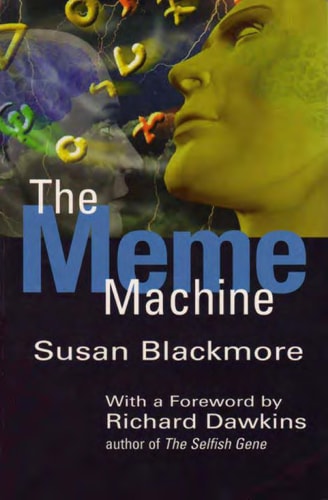
Similar Books





Reader Comments
Share Your Thoughts
No comments yet. Be the first to share your thoughts!