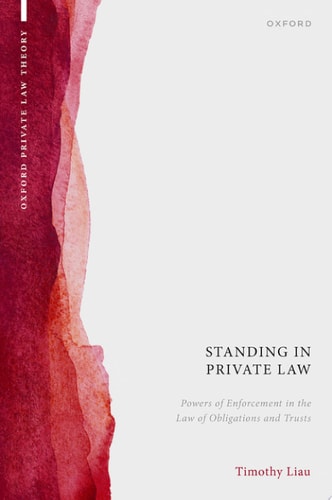
Standing in Private Law: Powers of Enforcement in the Law of Obligations and Trusts
0
0
As an Amazon Associate and affiliate partner, Menrva Books earns from qualifying purchases. Learn more
Author Description
Standing in Private Law: Powers of Enforcement in the Law of Obligations and Trusts develops the idea that we should attend more to 'standing', conceived as a power to hold another accountable before a court as a distinct private law concept. Prominent lawyers have claimed that private law does not have or need standing rules, yet this seems implausible. If private law is obligation-imposing, we need rules about who can sue on these obligations to hold their bearers accountable. This book argues that a reason why standing has been relatively overlooked and under-conceptualized, receiving meagre attention from private lawyers, is because it has been obscured from plain sight: it has been swallowed up by the more dominant and capacious concept of a 'right'. However, standing is a distinct and separable private law concept that can and should be distinguished more clearly from 'right'. Doing so is necessary for the continued rational development of private law doctrine. It is also necessary for a deeper theoretical understanding of standing's significance, and its place within the remedial apparatus of private law. This book argues that an implicit standing rule exists across the law of obligations. It examines its justifiability, and the justifiability of exceptions to the rule. It also shows how and why recognising standing's distinctiveness can help us to interpret, develop, and resolve debates within different areas of private law, including the laws of contract, torts, unjust enrichments, and relatedly, the law of trusts.
Menrva's Summary
THE THESIS
This book investigates the conceptual necessity of 'standing' as a distinct mechanism for accountability within private law, challenging the prevailing view that standing is merely an extension of rights. Timothy Liau, a scholar in private law theory, utilizes a doctrinal and analytical framework to argue that standing has been obscured by the broader concept of 'rights'. He posits that by isolating standing as a separate power to hold others accountable, legal practitioners can better interpret and resolve complex debates across the law of obligations and trusts.
THE SCOPE MAP
What You Will Find
- A theoretical framework distinguishing standing from rights in private law.
- An analysis of implicit standing rules within the law of obligations.
- Examination of exceptions to standing rules and their justifiability.
- Application of the standing concept to contract, tort, unjust enrichment, and trust law.
Scope Limits
- The book focuses primarily on private law doctrine rather than public law standing rules.
- It does not provide a comprehensive historical survey of standing across all global jurisdictions.
THE AUTHORITY PERSPECTIVE
Legal scholars and practitioners view this work as a significant contribution to the theoretical underpinnings of private law doctrine. Experts highlight the text as a rigorous examination that challenges established assumptions regarding the relationship between rights and enforcement powers.
Page Count:
368
Publication Date:
2023-01-01
Publisher:
Oxford University Press
ISBN-10:
0192869663
ISBN-13:
9780192869661
Jurisprudence
Private Law
Contract law
Tort Law
Law
Trusts Law
Legal Theory
Community Tags
Similar Books