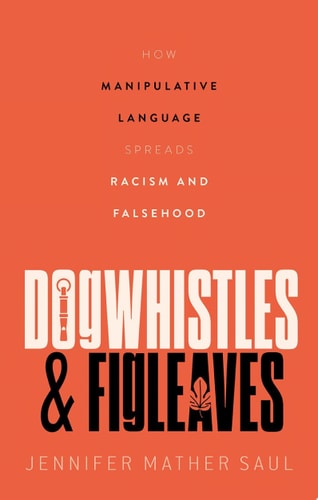
Dogwhistles and Figleaves: How Manipulative Language Spreads Racism and Falsehood
0
0
As an Amazon Associate and affiliate partner, Menrva Books earns from qualifying purchases. Learn more
Author Description
Pinpoints how "dogwhistles" and "figleaves," two kinds of linguistic trick, distort political discourse and normalize racismIt is widely accepted that political discourse in recent years has become more openly racist and more accepting of wildly implausible conspiracy theories. Dogwhistles and Figleaves explores ways in which such changes--both of which defied previously settled norms of political speech--have been brought about. Jennifer Saul shows that two linguistic devices, dogwhistles and figleaves, have played a crucial role. Some dogwhistles (such as "88", used by Nazis online to mean "Heil Hitler") serve to disguise messages that would otherwise be rejected as unacceptable, allowing them to be transmitted surreptitiously. Other dogwhistles (like the 1988 "Willie Horton" ad) work by influencing people in ways that they are not aware of, and which they would likely reject were they aware. Figleaves (such as "just asking questions") take messages that could easily be recognized as unacceptable, and provide just enough cover that people become more willing to accept them. Saul argues that these devices are important for the spread of racist discourse. She also shows how they contribute to the transmission of norm-violating discourse more generally, focusing on the case of wildly implausible conspiracist speech. Together, these devices have both exploited and widened existing divisions in society, and normalized racist and conspiracist speech. This book is the first full-length exploration of dogwhistles and figleaves. It offers an illuminating and disturbing view of the workings of contemporary political discourse.
Menrva's Summary
THE THESIS
This book investigates how specific linguistic mechanisms, identified as dogwhistles and figleaves, facilitate the spread of racist rhetoric and conspiratorial falsehoods within contemporary political discourse. Jennifer Mather Saul, a professor of philosophy, utilizes a framework rooted in linguistic theory and political analysis to examine how these devices bypass social norms. By dissecting the mechanics of coded language and plausible deniability, the author argues that these tools have significantly altered the boundaries of acceptable public speech and deepened societal polarization.
THE SCOPE MAP
What You Will Find
- Analysis of dogwhistle communication, including covert signaling and subconscious influence.
- Examination of figleaf devices that provide cover for otherwise unacceptable statements.
- Case studies ranging from political advertisements to online extremist symbology.
- Theoretical exploration of how these devices normalize extremist and conspiracist narratives.
Scope Limits
- The text focuses primarily on political and social discourse rather than psychological clinical studies.
- It does not provide a comprehensive history of all forms of political propaganda.
THE AUTHORITY PERSPECTIVE
Experts identify this work as a foundational text for understanding the intersection of philosophy of language and modern political communication. Readers frequently note the clarity of the author's arguments despite the complex nature of the linguistic phenomena being analyzed.
Page Count:
240
Publication Date:
2024-01-01
Publisher:
Oxford University Press
ISBN-10:
0192871757
ISBN-13:
9780192871756
Sociology
Linguistics
Communication Studies
Community Tags
Similar Books