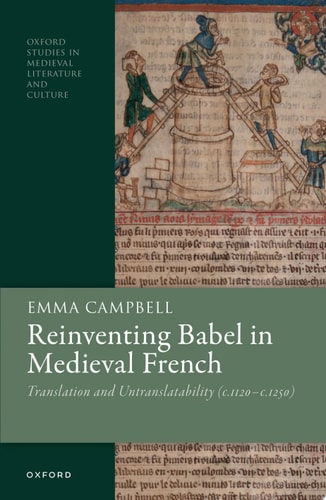
Reinventing Babel in Medieval French: Translation and Untranslatability (c. 1120-c. 1250)
0
0
As an Amazon Associate and affiliate partner, Menrva Books earns from qualifying purchases. Learn more
Author Description
How can untranslatability help us to think about the historical as well as the cultural and linguistic dimensions of translation? For the past two centuries, theoretical debates about translation have responded to the idea that translation overcomes linguistic and cultural incommensurability, while never inscribing full equivalence. More recently, untranslatability has been foregrounded in projects at the intersections between translation studies and other disciplines, notably philosophy and comparative literature. The critical turn to untranslatability re-emphasizes the importance of translation's negotiation with foreignness or difference and prompts further reflection on how that might be understood historically, philosophically, and ethically. If translation never replicates a source exactly, what does it mean to communicate some elements and not others? What or who determines what is translatable, or what can or cannot be recontextualized? What linguistic, political, cultural, or historical factors condition such determinations? Central to these questions is the way translation negotiates with, and inscribes asymmetries among, languages and cultures, operations that are inevitably ethical and political as well as linguistic.This book explores how approaching questions of translatability and untranslatability through premodern texts and languages can inform broader interdisciplinary conversations about translation as a concept and a practice. Working with case studies drawn from the francophone cultures of Flanders, England, and northern France, it explores how medieval texts challenge modern definitions of language, text, and translation and, in so doing, how such texts can open sites of variance and non-identity within what later became the hegemonic global languages we know today.
Menrva's Summary
THE THESIS
This book investigates how the concept of untranslatability functions as a critical lens for understanding the historical, cultural, and linguistic dimensions of translation in premodern texts. Dr. Emma Campbell, a scholar of medieval French literature, utilizes a framework that bridges translation studies with philosophy and comparative literature. She argues that medieval texts from the 12th and 13th centuries challenge modern, hegemonic definitions of language and equivalence, revealing how translation historically negotiates with foreignness and asymmetry.
THE SCOPE MAP
What You Will Find
- Analysis of francophone cultural production in Flanders, England, and northern France between 1120 and 1250.
- A theoretical framework applying the concept of untranslatability to premodern linguistic contexts.
- Examination of the ethical and political implications of translation practices in the medieval period.
Scope Limits
- The study is restricted to the specific timeframe of c. 1120 to c. 1250.
- It focuses primarily on medieval French and related regional linguistic interactions rather than a global survey of translation history.
THE AUTHORITY PERSPECTIVE
Scholars in the field of medieval studies recognize this work as a significant contribution to the intersection of philology and translation theory. Readers frequently note the academic density of the prose and the author's rigorous application of contemporary theoretical concepts to historical source material.
Page Count:
352
Publication Date:
2024-01-01
Publisher:
Oxford University Press
ISBN-10:
0192871714
ISBN-13:
9780192871718
History
Translating and interpreting
Linguistics
French literature
Translation Studies
Literary Criticism
Community Tags
Other Editions(2)
Similar Books


Reader Comments
Share Your Thoughts
No comments yet. Be the first to share your thoughts!