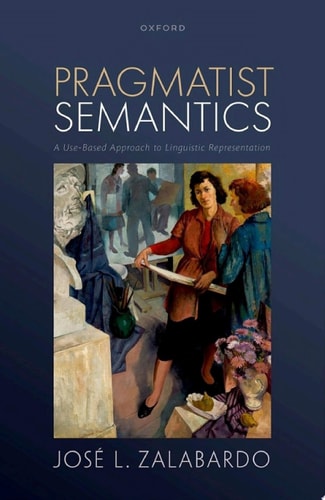
Pragmatist Semantics: A Use-Based Approach to Linguistic Representation
0
0
As an Amazon Associate and affiliate partner, Menrva Books earns from qualifying purchases. Learn more
Author Description
José L. Zalabardo defends a pragmatist account of what grounds the meaning of central semantic discourses—ascriptions of truth, of propositional attitudes, and of meanings. He argues that it is the procedures that regulate acceptance and rejection that give the sentences of these discourses their meanings, and explores the application of the pragmatist template to ethical discourse. The pragmatist approach is presented as an alternative to representationalist accounts of the meaning grounds of declarative sentences, according to which a sentence has the meaning it has as a result of links with the bits of the world that it purports to represent. Zalabardo develops a version of the open-question argument to support the claim that the meaning grounds of the discourses he focuses on cannot receive representationalist accounts. It is generally assumed that a declarative sentence cannot perform the function of representing the world unless it has a representationalist meaning ground. Zalabardo rejects this assumption, arguing that sentences with pragmatist meaning grounds can represent the world in exactly the same sense that sentences with representationalist meaning grounds do. This requires that there are states of affairs that the target sentences represent as obtaining, and Zalabardo develops an account of the nature of the states of affairs that can play this role for sentences with pragmatist meaning grounds. Pragmatist Semantics concludes by developing the suggestion that the meaning grounds of all our representational discourses might be ultimately pragmatist.
Menrva's Summary
THE THESIS
This book investigates whether the meaning of central semantic discourses can be grounded in the procedures that regulate acceptance and rejection rather than in representationalist links to the world. Prof. José L. Zalabardo, a scholar in the philosophy of language, challenges the prevailing assumption that declarative sentences require representationalist meaning grounds to function. He proposes a pragmatist framework that accounts for truth, propositional attitudes, and ethical discourse, arguing that such sentences can represent the world effectively without relying on traditional representationalist foundations.
THE SCOPE MAP
What You Will Find
- A pragmatist account of semantic discourses including truth and propositional attitudes.
- An application of the pragmatist template to ethical discourse.
- A revised version of the open-question argument against representationalism.
- An analysis of the nature of states of affairs in a pragmatist semantic system.
Scope Limits
- The text focuses primarily on semantic and representationalist theory rather than broader historical surveys of pragmatism.
- It does not provide an exhaustive analysis of every possible linguistic discourse, focusing instead on specific target areas.
THE AUTHORITY PERSPECTIVE
Experts in the philosophy of language recognize this work as a rigorous challenge to standard representationalist paradigms. Readers frequently note the high level of technical density in the prose, making it most suitable for advanced students and professional philosophers.
Page Count:
249
Publication Date:
2023-01-01
Publisher:
OUP Oxford
ISBN-10:
0192874888
ISBN-13:
9780192874887
Philosophy
Philosophy of
Linguistics
Logic
Semantics
Pragmatism
Community Tags
Similar Books