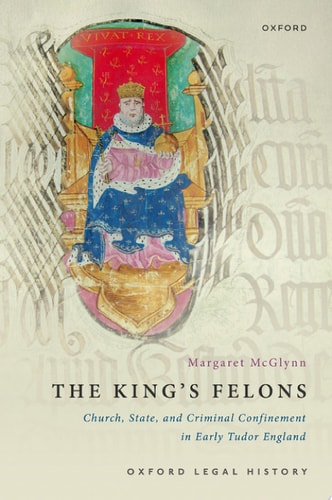
The King's Felons: Church, State and Criminal Confinement in Early Tudor England
0
0
As an Amazon Associate and affiliate partner, Menrva Books earns from qualifying purchases. Learn more
Author Description
The King's Felons examines the subtle but intentional development of criminal confinement as an alternative to capital punishment in early Tudor England. As the judicial establishment looked for ways to enhance law and order without provoking political opposition, they increasingly turned to two traditional mitigations of criminal punishment: benefit of clergy and sanctuary.Often reviled as corrupt clerical rights which served to undermine secular authority and the rule of law, benefit of clergy and sanctuary in fact provided the justices with room to manoeuvre, allowing them to punish a larger number of felons less harshly while avoiding political scrutiny. The King's Felons explores the evolution of this approach over a period of sixty years, allowing us to see not only the internal development of both law and process, but the ways in which the judicial system responded to external pressures.The dissolution of the monasteries between 1536 and 1540, together with the steady erosion of the wealth and power of the bishops, meant that the institutional and financial foundations on which the justices built this system began to crumble as it was reaching fruition. Over the next two decades they scrambled, with limited success, to secure some small vestiges of the system they had built. The epilogue connects the state of the system in the aftermath of this collapse to our existing understanding of the system in the later part of the century.Providing the first detailed study of criminal justice in the early Tudor period, The King's Felons highlights the role of the Church in the administration of criminal justice and reframes our understanding of many significant acts of the Reformation parliament. This book is a must-read for students and scholars of Tudor history, legal historians and those interested in the role of the church with regard to politics, law, and crime.
Menrva's Summary
THE THESIS
This book investigates how early Tudor judicial authorities utilized clerical privileges like sanctuary and benefit of clergy to manage criminal confinement as an alternative to capital punishment. Margaret McGlynn, a scholar of medieval and early modern legal history, utilizes extensive archival research from the early Tudor period to demonstrate how the state navigated political pressures. She argues that these traditional clerical rights were not merely corrupt loopholes, but functional tools that allowed the judicial system to adapt to changing social and political landscapes before the Reformation disrupted their foundations.
THE SCOPE MAP
What You Will Find
- Analysis of the evolution of benefit of clergy and sanctuary over a sixty-year period.
- Examination of the impact of the dissolution of the monasteries on judicial administration.
- Investigation into the interplay between secular law and ecclesiastical authority.
Scope Limits
- The study focuses primarily on the early Tudor period and does not provide a comprehensive history of English criminal law beyond the late sixteenth century.
THE AUTHORITY PERSPECTIVE
Historians and legal scholars recognize this work as a significant contribution to the understanding of Tudor judicial administration and the practical application of Reformation-era policies. Readers frequently note the academic density of the prose, which provides a rigorous examination of institutional shifts during a period of intense political transition.
Page Count:
400
Publication Date:
2023-06-10
Publisher:
Oxford University Press
ISBN-10:
0192887688
ISBN-13:
9780192887689
History
Law history
Reformation
Legal History
Criminal Law
Tudor England
Church History
Community Tags
Similar Books