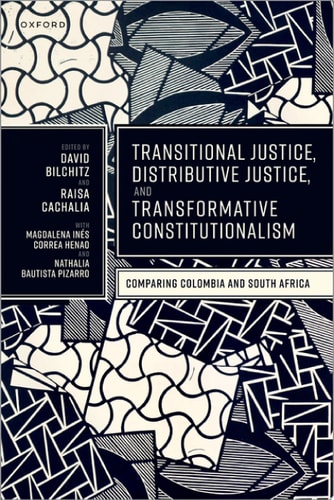
Transitional Justice, Distributive Justice, and Transformative Constitutionalism: Comparing Colombia and South Africa
0
0
As an Amazon Associate and affiliate partner, Menrva Books earns from qualifying purchases. Learn more
Author Description
Emerging from national pasts marred by violence, conflict, and injustice, South African and Colombian societies have sought to establish futures founded on equality, democracy, and constitutionalism. Transitional Justice, Distributive Justice, and Transformative Constitutionalism: Comparing Colombia and South Africa offers the first dedicated scholarly comparison of the two countries in relation to the intersecting ideas of transitional justice, distributive justice, and transformative constitutionalism. Featuring contributions by Colombian and South African authors, this volume richly examines each country from a range of thematic perspectives as the basis for deep reflection and comparison between them.Transitional Justice, Distributive Justice, and Transformative Constitutionalism brings together three interconnected concepts: the need for redress of past historical wrongs, the imperative to ensure fairness in the distribution of resources, and the commitment to law-governed social change mediated through a constitution. Part one explores innovative approaches to transitional justice that go beyond law, such as novel philosophical approaches to reconciliation, the use of art to address past wrongs, and the role of museums in memorialising the past. Part two considers one of the central components of transformative constitutionalism: socio-economic rights. It addresses the role of history in the interpretation of socio-economic rights and the procedural mechanisms that enable access to these rights. Part three looks at the development of legal structures designed to achieve both transitional and distributive justice in the areas of indigenous people's rights, procedural law, and international law.A timely work of innovative methodology and rare engagement between two constitutional democracies in the Global South, this title will be of interest to academics working in the fields of transitional justice, distributive justice, and transformative constitutionalism in
Menrva's Summary
THE THESIS
This volume investigates how the intersection of transitional justice, distributive justice, and transformative constitutionalism functions as a framework for addressing historical violence and systemic inequality in post-conflict societies. Editors David Bilchitz and Raisa Cachalia curate a collection of essays from Colombian and South African scholars who analyze the legal and social mechanisms used by these two nations to transition toward democratic stability. The text argues that constitutional law serves as a primary vehicle for both redressing past wrongs and ensuring equitable resource distribution.
THE SCOPE MAP
What You Will Find
- Comparative analysis of constitutional frameworks in Colombia and South Africa
- Examination of socio-economic rights and procedural legal mechanisms
- Exploration of non-legal approaches to reconciliation, including art and memorialization
- Studies on indigenous rights and international law applications
Scope Limits
- The analysis is restricted to the specific constitutional and legal developments within Colombia and South Africa
- The text does not provide a comprehensive global survey of all post-conflict nations
THE AUTHORITY PERSPECTIVE
Experts identify this volume as a significant contribution to comparative constitutional law, particularly for its focus on the Global South. Scholars frequently note the academic density of the prose and the utility of the comparative methodology for researchers in human rights and transitional justice.
Page Count:
512
Publication Date:
2024-01-01
Publisher:
Oxford University Press
ISBN-10:
0192887629
ISBN-13:
9780192887627
Law
Sociology
Constitutional Law
International relations
Human rights
Community Tags
Similar Books

Reader Comments
Share Your Thoughts
No comments yet. Be the first to share your thoughts!