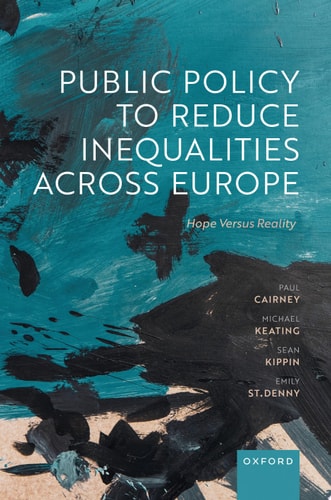
Public Policy to Reduce Inequalities Across Europe: Hope Versus Reality
0
0
As an Amazon Associate and affiliate partner, Menrva Books earns from qualifying purchases. Learn more
Author Description
This is an open access title available under the terms of a CC BY-NC-ND 4.0 International licence. It is free to read at Oxford Scholarship Online and offered as a free PDF download from OUP and selected open access locations.There is a broad consensus across European states and the EU that social and economic inequality is a problem that needs to be addressed. Yet inequality policy is notoriously complex and contested. This book approaches the issue from two linked perspectives. First, a focus on functional requirements highlights what policymakers think they need to deliver policy successfully, and the gap between their requirements and reality. We identify this gap in relation to the theory and practice of policy learning, and to multiple sectors, to show how it manifests in health, education, and gender equity policies. Second, a focus on territorial politics highlights how the problem is interpreted at different scales, subject to competing demands to take responsibility. This contestation and spread of responsibilities contributes to different policy approaches across spatial scales. We conclude that governments promote many separate equity initiatives, across territories and sectors, without knowing if they are complementary or contradictory. This outcome could reflect the fact that ambiguous policy problems and complex policymaking processes are beyond the full knowledge or control of governments. It could also be part of a strategy to make a rhetorically radical case while knowing that they will translate into safer policies. It allows them to replace debates on values, regarding whose definition of equity matters and which inequalities to tolerate, with more technical discussions of policy processes. Governments may be offering new perspectives on spatial justice or new ways to reduce political attention to inequalities.
Menrva's Summary
THE THESIS
This book investigates the persistent gap between the stated goals of European governments to reduce social and economic inequality and the actual outcomes of their policy interventions. The authors, a team of political scientists including Paul Cairney and Michael Keating, utilize a framework that combines policy theory with territorial politics to analyze why inequality remains a complex and often unresolved issue. They argue that the fragmentation of policy across sectors and scales often masks a lack of strategic coherence, suggesting that governments may prioritize technical process over substantive value-based reform.
THE SCOPE MAP
What You Will Find
- Analysis of policy learning theories in the context of inequality reduction
- Comparative studies across health, education, and gender equity sectors
- Examination of territorial politics and the distribution of responsibility across different governance scales
- Discussion on the strategic use of ambiguous policy language by state actors
Scope Limits
- The text does not provide a comprehensive manual for specific policy implementation
- It does not offer a singular solution for eliminating inequality across all European states
THE AUTHORITY PERSPECTIVE
Experts identify this work as a significant contribution to the study of multi-level governance and policy failure. Readers frequently note the academic density of the prose, which is well-suited for scholars and practitioners interested in the intersection of political theory and social policy.
Page Count:
217
Publication Date:
2022-11-25
Publisher:
Oxford Univ Pr
ISBN-10:
0192898582
ISBN-13:
9780192898586
Politics
Economics
Sociology
New Used & Rental Textbooks
Public Policy
Community Tags
Similar Books










Reader Comments
Share Your Thoughts
No comments yet. Be the first to share your thoughts!