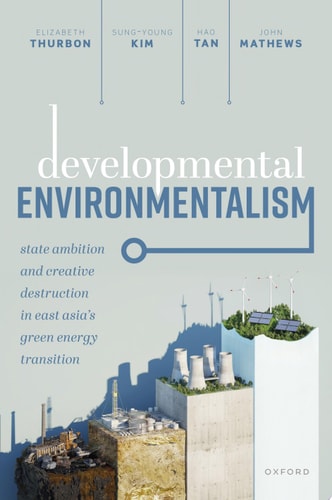
Developmental Environmentalism: State Ambition and Creative Destruction in East Asia's Green Energy Transition
0
0
As an Amazon Associate and affiliate partner, Menrva Books earns from qualifying purchases. Learn more
Author Description
Why has East Asia emerged as the global leader in green energy industries but - until recently - lagged on carbon emission reduction? What is new and distinctive about East Asia's approach to the green energy transition? And what does this approach mean for the world? Developmental Environmentalism provides the first comprehensive account of East Asia's green energy shift. It highlights the powerful and symbiotic role of state ambition, geostrategic competition, and capitalist market dynamics in driving forward the region's greening efforts. Through an analysis of the ambitious national strategies of China and South Korea, the authors show how state actors have pursued a distinctively East Asian approach to transforming their energy systems, involving first the rapid creation of new green energy industries and then the coordinated destruction of fossil-fuel incumbencies. This approach - described as 'Developmental Environmentalism' - is aimed at establishing East Asian economies as leaders in the green industries of the future, while at the same time addressing the pressing environmental, social and political problems associated with the carbon-intensive industries of the past. By developing four detailed, longitudinal case studies of green industry creation and fossil-fuel phase out in China and Korea, the authors identify the key successes and failures of East Asia's green shift to date and anticipate its most likely future trajectory. Based on their findings, the authors reject the idea that East Asia's greening strategies are mere exercises in 'greenwashing' or fossil-fuelled 'business as usual'. Rather, there is something fundamentally transformative underway in the region at the level of elite ideation, strategic ambition, and policy action; the green energy shift represents much more than continuity in Asia's erstwhile developmental states. To execute their analysis, the authors synthesise insights from cutting-edge Developmental State and Schumpeterian theory.
Menrva's Summary
THE THESIS
How do East Asian states reconcile their status as global leaders in green energy industries with their historical reliance on carbon-intensive growth? The authors, a team of scholars specializing in political economy and environmental policy, argue that China and South Korea have adopted a model of 'Developmental Environmentalism.' This framework posits that state-led industrial policy, driven by geostrategic competition and Schumpeterian creative destruction, is actively dismantling fossil-fuel incumbencies to secure dominance in future green markets.
THE SCOPE MAP
What You Will Find
- Longitudinal case studies of green industry development in China and South Korea.
- Analysis of the intersection between state ambition and capitalist market dynamics.
- Application of Developmental State and Schumpeterian economic theories to environmental transitions.
Scope Limits
- The analysis does not provide a comprehensive global comparison beyond the focus on China and South Korea.
- The text does not offer prescriptive policy advice for non-developmental state economies.
THE AUTHORITY PERSPECTIVE
Experts recognize this work as a significant contribution to the study of state-led environmental transitions, noting its departure from simplistic 'greenwashing' narratives. Readers frequently highlight the academic density of the prose and the authors' rigorous application of political economy frameworks to contemporary climate policy.
Page Count:
272
Publication Date:
2023-08-02
Publisher:
Oxford University Press
ISBN-10:
0192897799
ISBN-13:
9780192897794
Economics
Asian Studies
Sustainability
Natural Resources
Energy policy
Community Tags
Similar Books



Reader Comments
Share Your Thoughts
No comments yet. Be the first to share your thoughts!