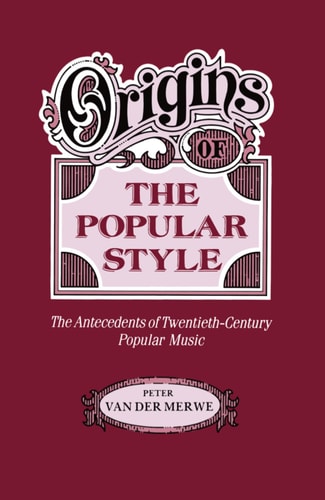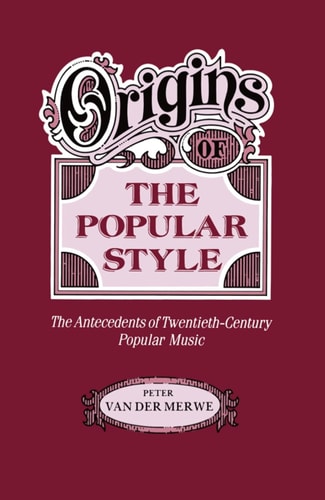
Origins of the Popular Style: The Antecedents of Twentieth-Century Popular Music
0
0
As an Amazon Associate and affiliate partner, Menrva Books earns from qualifying purchases. Learn more
Author Description
Here, for the first time, is a book which analyses popular music from a musical, as opposed to a sociological, biographical, or political point of view. Peter van der Merwe has made an extensive survey of Western popular music in all its forms - blues, ragtime, music hall, waltzes, marches, parlour ballads, folk music - uncovering the common musical language which unites these disparate styles. The book examines the split between `classical' and `popular' Western music in the nineteenth and early twentieth centuries, shedding light, in the process, on the `serious' music of the time. With a wealth of musical illustrations ranging from Strauss waltzes to Mississippi blues and from the Middle Ages to the 1920s, the author lays bare the tangled roots of the popular music of today in a book which is often provocative, always readable, and outstandingly comprehensive in its scope.
Menrva's Summary
THE THESIS
How did the disparate genres of Western popular music evolve from a shared musical language? Peter Van der Merwe, a scholar of musicology, challenges the traditional sociological approach to music history by focusing strictly on the technical and structural components of composition. He argues that the divide between 'classical' and 'popular' music is a construct that obscures the common harmonic and melodic roots shared by diverse styles like blues, ragtime, and folk.
THE SCOPE MAP
What You Will Find
- Comparative analysis of Western popular music forms including blues, ragtime, waltzes, and parlour ballads.
- Examination of the historical split between formal classical music and popular music in the 19th and early 20th centuries.
- Extensive use of musical notation and thematic illustrations ranging from the Middle Ages to the 1920s.
Scope Limits
- The text does not focus on the sociological, biographical, or political contexts of the musicians or their eras.
- The analysis concludes at the 1920s and does not cover the evolution of popular music in the late 20th century.
THE AUTHORITY PERSPECTIVE
Experts and musicologists frequently cite this work as a foundational text for understanding the technical lineage of Western popular music. Readers often note the academic density of the prose, which requires a working knowledge of music theory to fully appreciate the author's arguments.
Page Count:
368
Publication Date:
1989-12-07
Publisher:
Oxford University Press
ISBN-10:
0193161214
ISBN-13:
9780193161214
Music
Music History
Popular music
Cultural History
Music theory