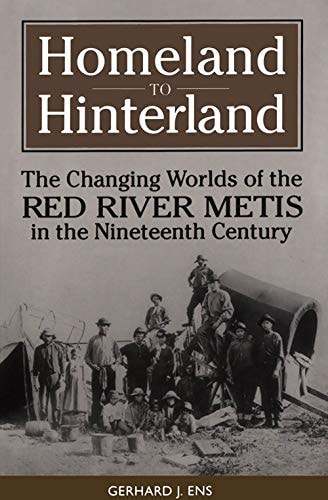
Homeland to Hinterland: The Changing Worlds of the Red River Métis in the Nineteenth Century
0
0
As an Amazon Associate and affiliate partner, Menrva Books earns from qualifying purchases. Learn more
Author Description
Most writing on Metis history has concentrated on the Resistance of 1869-70 and the Rebellion of 1885, without adequately explaining the social and economic origins of the Metis that shaped those conflicts. Historians have often emphasized the aboriginal aspect of the Metis heritage, stereotyping the Metis as a primitive people unable or unwilling to adjust to civilized life and capitalist society. In this social and economic history of the Metis of the Red River Settlement, specifically the parishes of St Francois-Xavier and St Andrew's, Gerhard Ens argues that the Metis participated with growing confidence in two worlds: one Indian and pre-capitalist, the other European and capitalist. Ens maintains that Metis identity was not defined by biology or blood but rather by the economic and social niche they carved out for themselves within the fur trade. Ens finds that the Metis, rather than being overwhelmed, adapted quickly to the changed economic conditions of the 1840s and actually influenced the nature of change. The opening of new markets and the rise of the buffalo robe trade fed a `cottage industry' whose increasing importance had significant repercussions for the maintenance of ethnic boundaries, the nature of Metis response to the Riel Resistance, and the eventual decline of the Red River Settlement as a Metis homeland.
Menrva's Summary
THE THESIS
This book challenges conventional narratives of Métis history by examining their complex social and economic integration into both Indigenous and capitalist worlds during the nineteenth century. Gerhard Ens argues that Métis identity was forged through their economic and social positioning within the fur trade, rather than by biological definitions. The study focuses on the Red River Settlement, specifically the parishes of St. Francois-Xavier and St. Andrew's, to demonstrate how the Métis actively participated in and influenced changing economic conditions. Ens posits that the Métis adapted swiftly to new markets and the burgeoning buffalo robe trade, which in turn shaped their ethnic boundaries and responses to later conflicts.
THE SCOPE MAP
- Analysis of the social and economic origins of the Métis prior to the 1869-70 Resistance and 1885 Rebellion.
- Critique of historical interpretations that stereotype the Métis as primitive and unable to adapt to capitalist society.
- Examination of the dual participation of the Métis in Indigenous, pre-capitalist economies and European, capitalist economies.
- Argument that Métis identity was defined by their economic and social niche within the fur trade.
- Evidence of the Métis' rapid adaptation to changed economic conditions in the 1840s.
- Exploration of the influence of the buffalo robe trade and its 'cottage industry' on Métis society.
- Discussion of the repercussions of economic changes on ethnic boundaries and Métis responses to the Riel Resistance.
- Analysis of the factors contributing to the decline of the Red River Settlement as a Métis homeland.
THE AUTHORITY PERSPECTIVE
This work is regarded as a significant contribution to Métis historiography, offering a nuanced perspective that moves beyond the traditional focus on the Riel Resistance. Ens's argument that Métis identity was shaped by economic participation rather than solely by heritage provides a new framework for understanding their historical trajectory. The book is noted for its detailed examination of the social and economic structures within specific Red River communities. It effectively challenges earlier stereotypes by highlighting the Métis' agency and adaptability in the face of profound societal changes.
Page Count:
268
Publication Date:
1996-01-01
Publisher:
University of Toronto Press
ISBN-10:
0802008356
ISBN-13:
9780802008350
History
Non-Fiction
Economic History
Social History
Community Tags
Similar Books