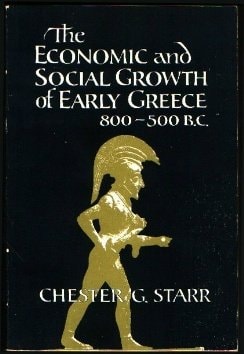
The Economic and Social Growth of Early Greece: 800-500 B.C.
0
0
As an Amazon Associate and affiliate partner, Menrva Books earns from qualifying purchases. Learn more
Author Description
Details the immense economic and social changes the ancient Greek world underwent in the three centuries before 500 B.C., developing from rural self-sufficient villages around the Aegean to a complex economic structure embracing much of the Mediterranean and centered in cities.
Menrva's Summary
THE THESIS
This work investigates the fundamental economic and social transformations that facilitated the transition of early Greece from isolated, agrarian communities to a sophisticated, interconnected Mediterranean civilization. Chester G. Starr, a noted historian of the ancient world, utilizes archaeological evidence and historical analysis to map the evolution of Greek society between 800 and 500 B.C. The text argues that the expansion of trade, the rise of the polis, and shifting social hierarchies were the primary drivers of this development. By examining the material culture and political structures of the era, the author provides a framework for understanding how these small-scale villages integrated into a broader economic network.
THE SCOPE MAP
What You Will Find
- Analysis of the transition from rural self-sufficiency to urban-centered economic systems.
- Examination of trade routes and maritime expansion across the Mediterranean basin.
- Evaluation of social stratification and the development of the Greek polis.
- Synthesis of archaeological data and primary historical records from the Archaic period.
THE AUTHORITY PERSPECTIVE
Scholars and students of classical history frequently cite this text as a foundational study for understanding the structural changes in early Greek society. Readers often note the academic density of the prose, which provides a rigorous examination of the period's economic evolution.
Page Count:
280
Publication Date:
1978-04-13
Publisher:
Oxford University Press
ISBN-10:
0195022246
ISBN-13:
9780195022247
History
Economics
Ancient History
Sociology
Social Conditions
Community Tags
Similar Books