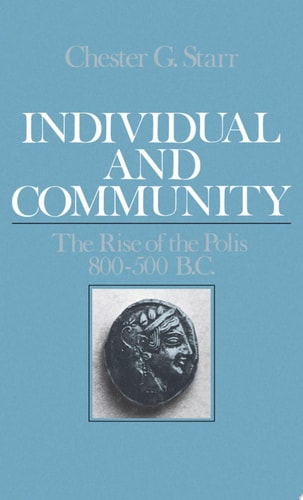
Individual and Community: The Rise of the Polis, 800-500 B.C.
0
0
As an Amazon Associate and affiliate partner, Menrva Books earns from qualifying purchases. Learn more
Author Description
During the three centuries from 800 to 500 B.C., the Greek world evolved from a primitive society--both culturally and economically--to one whose artistic products dominated all Mediterranean markets, supported by a wide overseas trade. In the following two centuries came the literary, philosophical, and artistic masterpieces of the classic area. Vital to this advance was the development of the polis, a collective institution in which citizens had rights as well as duties under the rule of law, a system hitherto unknown in human history. In this study, the first systematic exploration of the forces that created the political framework of Greek civilization, Chester Starr shows how the Greeks emerged form a Homeric world of individuals to the polis of 500 B.C. The age-old conflict between the self-serving demands of human beings and the less vocally-expressed needs of the community serves as the backbone of Starr's interdisciplinary analysis of the rise of the polis.
Menrva's Summary
THE THESIS
This study investigates the socio-political evolution of the Greek world between 800 and 500 B.C. to determine how the transition from individualistic Homeric society to the structured polis occurred. Chester G. Starr, a noted historian of antiquity, utilizes an interdisciplinary approach to analyze the economic, cultural, and political shifts that enabled this institutional development. By examining the tension between individual desires and communal obligations, Starr argues that the emergence of the polis established a foundational framework for Western governance and the rule of law.
THE SCOPE MAP
What You Will Find
- Analysis of the transition from primitive economic structures to Mediterranean market dominance.
- Examination of the political framework and the development of citizen rights and duties.
- Interdisciplinary synthesis of archaeological, literary, and historical evidence.
- Exploration of the conflict between self-serving human demands and communal institutional needs.
THE AUTHORITY PERSPECTIVE
Scholars and students of classical history recognize this work as a foundational text for understanding the structural origins of the Greek city-state. Readers frequently note the academic density of the prose, which provides a rigorous examination of the socio-political forces shaping early Greek civilization.
Page Count:
144
Publication Date:
1986-02-20
Publisher:
Oxford University Press
ISBN-10:
0195039718
ISBN-13:
9780195039719
History
Ancient History
Sociology
Politics & Government
Community Tags
Similar Books