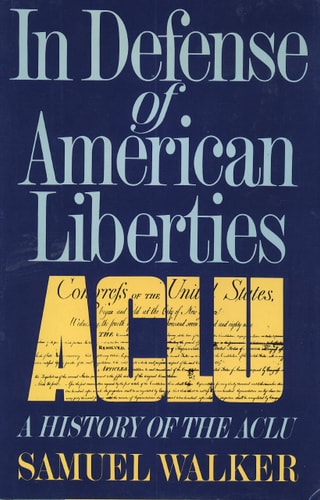
In Defense of American Liberties: A History of the ACLU
0
0
As an Amazon Associate and affiliate partner, Menrva Books earns from qualifying purchases. Learn more
Author Description
Throughout the 1988 Presidential campaign, George Bush drew cheers from supporters by attacking Michael Dukakis's membership in the American Civil Liberties Union (ACLU), an organization that he charged was out of the "mainstream" of American life. Indeed, throughout its history, the organization has championed some decidedly unpopular causes, including free speech rights for racist groups and due process for even the most vicious criminals.But as Samuel Walker argues in his provocative new book--the first comprehensive history of the ACLU--the organization has played a leading role in shaping principles of individual freedom that are now a cornerstone of American law and the way all of us conceive of personal liberty. It has been involved in most of the Supreme Court's landmark cases expanding individual rights, and today argues more cases before the Court than anyone but the federal government. In fact, as American Liberties makes clear, the organization has played a central role in creating that mythical American "mainstream" that its opponents so often invoke.In fascinating detail, Walker recounts the ACLU's stormy history since its founding in 1920 to fight for free speech. He explores its involvement in some of the most famous causes in American history, including the Scopes "Monkey Trial," the internment of Japanese-Americans during World War II, the Cold War anti-Communist witch hunts, and the civil rights movement. And he examines its most famous personalities, such as its puritan and autocratic founder Roger Baldwin; Felix Frankfurter, a long-time member who later voted against many ACLU cases while a Supreme Court justice; and Morris Ernst, who won the landmark case involving James Joyce's Ulysses and led the ACLU to take up the cause of free expression for sexually-frank publications.Walker deals candidly with the ACLU's less praiseworthy episodes--such as the expulsion of Elizabeth Gurley Flynn from the Board during the ACLU's anti-Communist phase, and
Menrva's Summary
THE THESIS
This book investigates how the American Civil Liberties Union evolved from a controversial advocacy group into a central architect of modern American legal principles regarding individual freedom. Samuel Walker, a professor of criminal justice, utilizes extensive archival research and historical analysis to argue that the ACLU's persistent defense of unpopular causes has fundamentally shaped the constitutional mainstream. He examines the organization's internal tensions and its external impact on Supreme Court jurisprudence to demonstrate its role in defining the boundaries of personal liberty in the United States.
THE SCOPE MAP
What You Will Find
- A comprehensive chronological history of the ACLU from its founding in 1920 through the late 20th century.
- Analysis of landmark Supreme Court cases involving free speech, due process, and civil rights.
- Biographical profiles of key figures including Roger Baldwin, Felix Frankfurter, and Morris Ernst.
- Critical examination of the organization's internal conflicts, including its anti-Communist purges and shifting policy stances.
THE AUTHORITY PERSPECTIVE
Experts recognize this work as the definitive historical account of the ACLU, frequently citing it for its balanced treatment of both the organization's successes and its internal failures. Readers often note the academic rigor of the prose, which provides a detailed look at the intersection of legal theory and political activism.
Page Count:
512
Publication Date:
1990-01-18
Publisher:
Oxford University Press
ISBN-10:
0195045394
ISBN-13:
9780195045390
Biography
Politics
History
Law
Civil Rights
Community Tags
Similar Books