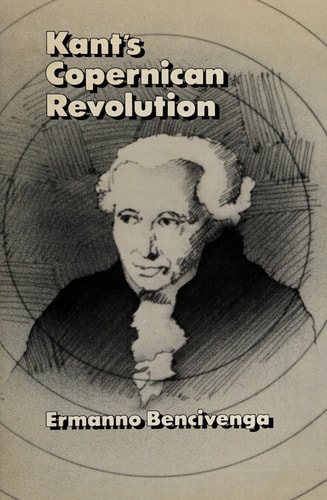
Kant's Copernican Revolution
0
0
As an Amazon Associate and affiliate partner, Menrva Books earns from qualifying purchases. Learn more
Author Description
This is a highly original, wide-ranging, and unorthodox discourse on the idea of philosophy contained in Kant's major work, the Critique of Pure Reason. Bencivenga proposes a novel explanation of the Critique's celebrated "obscurity." This great obstacle to reading Kant, Bencivenga argues, has nothing to do with Kant's being a bad writer or with his having anything very complicated to say; rather, it is the natural result of the kind of operation Kant was performing: a universal conceptual revolution. Bencivenga contends that in rejecting the traditional way of doing philosophy, Kant was proposing a paradigm shift comparable in magnitude to Copernicus's overthrow of the Ptolemaic view of the cosmos. Kant, however, was not successful in establishing his idea of philosophy as the new paradigm, and the old view persists in many contemporary versions. Bencivenga argues in favor of Kant's position, which he sees as entailing the view that the role of philosophy is to offer a plausible story about how objectivity might be grounded in certain principles of coherence of our mental states. This book is the story of Kant's revolutionary turnabout, what motivated it, and where it took him; it reveals Kant not only as a figure of historical importance, but as a source of ideas of great contemporary interest.
Menrva's Summary
THE THESIS
Ermanno Bencivenga investigates whether the perceived obscurity of Immanuel Kant's Critique of Pure Reason is a deliberate consequence of a radical, universal conceptual revolution rather than a failure of prose. Bencivenga, a scholar of philosophical history, utilizes a comparative framework to position Kant's work as a paradigm shift analogous to the Copernican revolution in astronomy. He argues that the persistence of traditional philosophical methods obscures the validity of Kant's original project, which sought to ground objectivity in the coherence of mental states. By re-evaluating the text, the author attempts to reclaim Kant's work as a relevant and functional model for contemporary philosophical inquiry.
THE SCOPE MAP
What You Will Find
- A critical re-examination of the Critique of Pure Reason as a revolutionary paradigm shift.
- An analysis of the historical and conceptual barriers that prevent modern readers from engaging with Kant's core arguments.
- A philosophical framework defining the role of philosophy as the construction of plausible stories regarding mental coherence.
- A comparative study between the Ptolemaic view of the cosmos and traditional pre-Kantian philosophical structures.
THE AUTHORITY PERSPECTIVE
Scholars and students of Kantian studies often note the provocative nature of Bencivenga's interpretation, which challenges standard academic readings of the Critique. The text is frequently cited for its accessible yet rigorous approach to complex epistemological questions, making it a distinct contribution to the discourse on Kant's legacy.
Page Count:
272
Publication Date:
1987-10-08
Publisher:
Oxford University Press
ISBN-10:
0195049578
ISBN-13:
9780195049572
Non-Fiction
Philosophy
Knowledge Theory
Epistemology
Community Tags
Similar Books