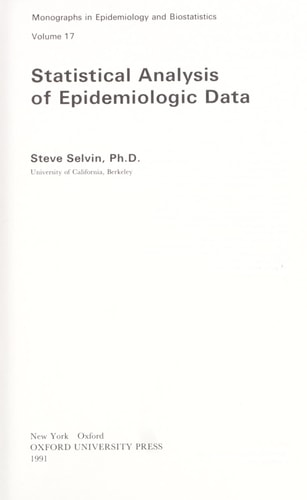
Statistical Analysis of Epidemiologic Data
0
0
As an Amazon Associate and affiliate partner, Menrva Books earns from qualifying purchases. Learn more
Author Description
This text combines applied and theoretical approaches to the analysis of epidemiologic issues. It goes beyond elementary material to deal with real problems generated by disease data, and delves into less usual areas such as the analysis of spatial distributions, survival data, proportional hazards regression, and "computer intensive" approaches to statistical estimation. Each method discussed in the text is illustrated with examples which include complete sets of data. Using actual data demonstrates the strengths and weaknesses of different analytic approaches in describing a disease process. The book's goal is to develop a clear understanding of analytic approaches to problems in epidemiological data analysis without relying on sophisticated mathematics and advanced statistical theory. Individuals with some background in epidemiology and statistics will find this a useful volume in the study of epidemiological analysis.
Menrva's Summary
THE THESIS
This text investigates the application of statistical methodologies to complex epidemiological data sets, bridging the gap between theoretical models and practical disease analysis. Professor Steve Selvin provides a framework that prioritizes the utility of analytic techniques over abstract mathematical proofs. By utilizing real-world data, the author demonstrates how specific statistical tools can be deployed to interpret disease processes, survival rates, and spatial distributions effectively.
THE SCOPE MAP
What You Will Find
- Analysis of spatial distributions and survival data in epidemiological contexts.
- Methodologies for proportional hazards regression and computer-intensive statistical estimation.
- Practical application of statistical techniques using complete, real-world data sets.
- Comparative evaluation of the strengths and weaknesses inherent in various analytic approaches.
THE AUTHORITY PERSPECTIVE
Experts and students in the field recognize this volume as a practical resource for those who possess foundational knowledge in epidemiology and statistics. Readers frequently note that the text successfully avoids overly dense mathematical theory while maintaining a rigorous focus on applied problem-solving.
Page Count:
400
Publication Date:
1991-08-01
Publisher:
Oxford University Press
ISBN-10:
0195067665
ISBN-13:
9780195067668
Science
Statistics
Public Health
Biostatistics
Epidemiology
Mathematics