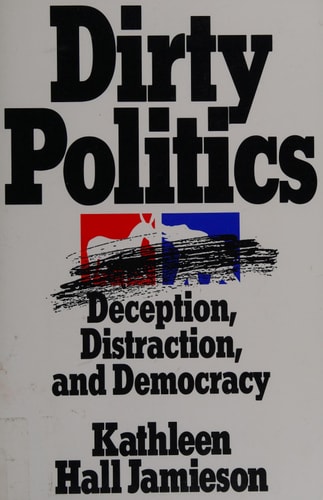
Dirty Politics: Deception, Distraction, and Democracy
0
0
As an Amazon Associate and affiliate partner, Menrva Books earns from qualifying purchases. Learn more
Author Description
Americans in recent years have become thoroughly disenchanted with our political campaigns, especially with campaign advertising and speeches. Each year, as November approaches, we are bombarded with visceral appeals that bypass substance, that drape candidates in the American flag but tell us nothing about what they'll do if elected, that flood us with images of PT-109 or Willie Horton, while significant issues--such as Kennedy's Addison's Disease or the looming S&L catastrophe--are left unexamined. And the press--the supposed safeguard of democracy--focuses on campaign strategy over campaign substance, leaving us to decide where the truth lies.In Dirty Politics, campaign analyst Kathleen Hall Jamieson provides an eye-opening look at political ads and speeches, showing us how to read, listen to, and watch political campaigns. Jamieson provides a sophisticated (and often humorous) analysis of advertising technique, describing how television ads use soft focus, slow motion, lyrical or patriotic music (Reagan used "I'm Proud to be an American") to place a candidate in a positive light, or quick cuts, black and white, videotape, and ominous music (for instance, the theme from "Jaws") to portray the opposition. She shows how ads sometimes mimic news spots to add authenticity (Edwin Edwards, in his race against David Duke, actually used former NBC correspondent Peter Hackis, who would begin an ad saying "This is Peter Hackis in Baton Rouge"). And Jamieson points out that consultants create inflammatory ads hoping that the major networks will pick them up and run them as news, giving the ad millions of dollars of free air time. The most striking example would be the Willie Horton ad, which the press aired repeatedly (as an example of negative advertising) long after the ad had ceased running. (In fact, it never ran on the major networks as an ad, only as news.)From a colorful, compact history of negative campaigning from Eisenhower to the present, to an in-depth commentary.
Menrva's Summary
THE THESIS
How do political campaigns utilize deceptive advertising and media manipulation to influence voter perception while undermining democratic substance? Kathleen Hall Jamieson, a prominent scholar in political communication, examines the evolution of campaign rhetoric and television advertising from the Eisenhower era through the late 20th century. She argues that the intersection of strategic consultant tactics and press complicity creates a political environment where image and distraction consistently supersede policy debate.
THE SCOPE MAP
What You Will Find
- A historical analysis of negative campaigning techniques from the 1950s to the 1990s.
- A breakdown of visual and auditory manipulation tactics used in television political spots.
- Case studies of high-profile campaign ads, including the Willie Horton spot and various candidate-specific messaging strategies.
- An examination of the symbiotic relationship between political consultants and news media outlets.
THE AUTHORITY PERSPECTIVE
Experts and political science students frequently cite this work as a foundational text for understanding the mechanics of modern political advertising. Readers often note that while the specific examples are dated, the analytical framework remains highly relevant for identifying contemporary media manipulation.
Page Count:
352
Publication Date:
1992-09-03
Publisher:
Oxford University Press
ISBN-10:
0195078543
ISBN-13:
9780195078541
Politics
History
Criticism Personal
Media Studies
Communication in politics
Communication
Politics Practical
Community Tags
Similar Books