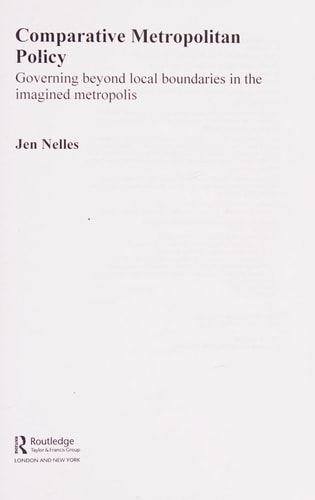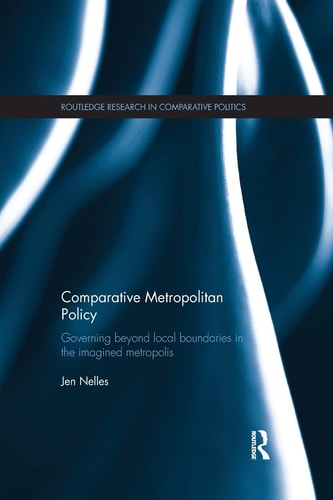
Comparative Metropolitan Policy Governing Beyond Local Boundaries in the Imagined Metropolis
0
0
As an Amazon Associate and affiliate partner, Menrva Books earns from qualifying purchases. Learn more
Author Description
How are metropolitan regions governed? What makes some regions more effective than others in managing policies that cross local jurisdictional boundaries? Political coordination among municipal governments is necessary to attract investment, rapid and efficient public transit systems, and to sustain cultural infrastructure in metropolitan regions. In this era of fragmented authority, local governments alone rarely possess the capacity to address these policy issues alone. This book explores the sources and barriers to cooperation and metropolitan policy making. It combines different streams of scholarship on regional governance to explain how and why metropolitan partnerships emerge and flourish in some places and fail to in others. It systematically tests this theory in the Frankfurt and Rhein-Neckar regions of Germany and the Toronto and Waterloo regions in Canada. Discovering that existing theories of metropolitan collective action based on institutions and opportunities are inconsistent, the author proposes a new theory of "civic capital", which argues that civic engagement and leadership at the regional scale can be important catalysts to metropolitan cooperation. The extent to which the actors hold a shared image of the metropolis and engage at that scale strongly influences the degree to which local authorities will be willing and able to coordinate policies for the collective development of the region. Metropolitan Governance and Policy will be of interest to students and scholars of comparative urban and metropolitan governance and sociology.
Menrva's Summary
THE THESIS
This book investigates the complex question of how metropolitan regions are governed and what factors contribute to the effectiveness of policies that extend beyond local boundaries. It examines the necessity of political coordination among municipal governments for attracting investment, developing public transit, and sustaining cultural infrastructure, arguing that local governments alone often lack the capacity to address these issues in an era of fragmented authority. The work explores the sources and barriers to cooperation in metropolitan policymaking, drawing on diverse scholarly streams to explain why metropolitan partnerships succeed in some regions and fail in others. It proposes a new theory of "civic capital," suggesting that regional-scale civic engagement and leadership are crucial catalysts for metropolitan cooperation, influenced by a shared image of the metropolis among actors.
THE SCOPE MAP
- Analysis of metropolitan governance effectiveness across different regions.
- Exploration of policy issues requiring cross-jurisdictional cooperation (investment, transit, cultural infrastructure).
- Examination of existing theories on metropolitan collective action.
- Introduction and testing of a new theory of "civic capital" for regional cooperation.
- Case studies of metropolitan regions in Germany (Frankfurt and Rhein-Neckar) and Canada (Toronto and Waterloo).
- Discussion of the influence of a shared regional image on policy coordination.
- Target audience: Students and scholars of comparative urban and metropolitan governance and sociology.
THE AUTHORITY PERSPECTIVE
The book is positioned as a significant contribution to the study of comparative urban and metropolitan governance, offering a novel theoretical framework. Its systematic testing of theories across distinct international case studies suggests a rigorous, evidence-based approach. The proposed "civic capital" theory aims to provide new insights into the dynamics of regional cooperation, which is a critical challenge for contemporary urban policymakers. The work is expected to be of interest to academics and students specializing in urban studies and public policy.
Page Count:
232
Publication Date:
2015-09-29
Publisher:
Routledge
ISBN-10:
1138186147
ISBN-13:
9781138186149
Non-Fiction
Economics
Politics
Public Policy
Comparative Politics
Urban Studies