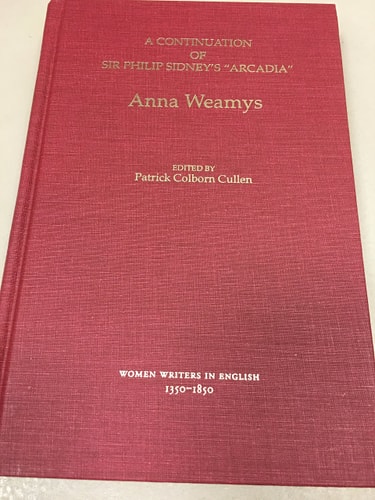
A Continuation of Sir Philip Sidney's Arcadia
0
0
As an Amazon Associate and affiliate partner, Menrva Books earns from qualifying purchases. Learn more
Author Description
Anna Weamys's A Continuation of Sir Philip Sidney's Arcadia is a woman's contribution to one of the dominant genres of her sex's readership in the seventeenth century: the heroic romance. Part of the considerable power and appeal of this work is its reduction of the heroic romance to a smaller scale. In its shorter length and its comparatively direct style, it avoids the fustian and bloat of the form. At the same time, it elaborates on the genre's stronger points--its playfulness and fantasy, its explorations of the nuances of sensibility--while not sacrificing its capacity for political statement. Weamys's Arcadia is an interesting and accessible story that, while it pairs well with Sidney, can stand on its own or be paired with other writers of romance like Shakespeare or Spenser. The first appearance of the text since the seventeenth century, this volume includes both a modernized and an old-spelling edition of the text.
Menrva's Summary
THE PULSE
Anna Weamys extends the narrative world of Sir Philip Sidney’s original work, navigating the complex interplay of courtly love and political intrigue. The protagonist must reconcile personal desires with the rigid expectations of heroic duty while facing external threats that challenge the stability of the realm. Weamys utilizes a narrative framework that mirrors the conventions of seventeenth-century romance, focusing on the internal development of characters within a highly stylized, aristocratic setting. The story operates under the logical constraints of the heroic tradition, where virtue and honor dictate the progression of events.
INSIDE THE PAGES
- Utilization of the heroic romance genre conventions
- Focus on the nuances of emotional sensibility
- Integration of political commentary within a fictional framework
- Stylistic reduction of the traditional, bloated heroic form
- Emphasis on playful and fantastical elements
- Exploration of courtly dynamics and social hierarchies
- Direct and accessible prose style compared to contemporary works
- Character-driven development of romantic and moral dilemmas
THE COLLECTIVE ECHO
Discussion often centers on how Weamys successfully adapts the sprawling nature of Sidney’s original into a more concise and readable format. Readers frequently highlight the author's ability to maintain the playfulness of the genre while introducing a distinct female perspective on seventeenth-century romance. Critics note that the work serves as a significant example of women's literary contributions during this period, effectively balancing fantasy with grounded political observation. The text is often praised for its accessibility, making it a valuable point of comparison for those studying the evolution of the romance form alongside contemporaries like Shakespeare or Spenser.
Page Count:
288
Publication Date:
1994-01-01
Publisher:
Oxford University Press
ISBN-10:
0195078845
ISBN-13:
9780195078848
Romance
classic
Historical
17th Century
Community Tags
Other Editions(2)
Similar Books