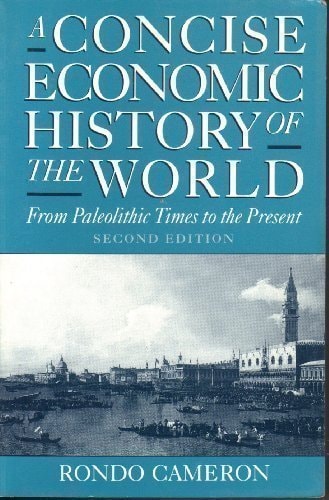
A Concise Economic History of the World: From Paleolithic Times to the Present
0
0
As an Amazon Associate and affiliate partner, Menrva Books earns from qualifying purchases. Learn more
Author Description
The second edition of this comprehensive economic history of the world from paleolithic times to the present takes into account the dramatic recent events that have completely realigned the economies and polities of Eastern Europe and the former Soviet Union, and offers additional backgroundand perspective on the non-European world, a completely revised chapter on non-Western economies on the eve of Western expansion, and a new chapter on the world economy at the end of the twentieth century. Grounded in modern economic theory, but written in non-technical language in an engagingnarrative style accessible even to non-specialists, the new edition highlights historic and recent events that have contributed to prosperity and material well-being--that is, to "development"--as well as those that have resulted in continued "underdevelopment" for large areas of the world. Thefirst half of the book surveys world history from ancient times to the eighteenth century, outlining the origins of Western prosperity. The second half investigates in detail the industrialization and urbanization that transformed Europe and America in the nineteenth and twentieth centuries.Cameron places the contemporary world economy, especially recent developments in Eastern Europe, the European Community, and the Persian Gulf, into broad historical perspective, making both the former East-West rivalry and the North-South split more understandable. Retaining the remarkable scope andaccessibility of the first edition, this remains the essential work for general readers and scholars who want to know more about how the world came to be as it is.
Menrva's Summary
THE THESIS
This work investigates the long-term factors that have driven global economic development and the persistent causes of underdevelopment across different civilizations. Rondo Cameron, a distinguished economic historian, utilizes modern economic theory to synthesize vast historical data into a coherent narrative. The text argues that understanding contemporary economic disparities requires a deep analysis of historical industrialization, urbanization, and the evolution of non-Western and Western economies from the Paleolithic era to the late twentieth century.
THE SCOPE MAP
What You Will Find
- Comprehensive survey of world economic development from ancient times to the late twentieth century.
- Analysis of the industrialization and urbanization processes in Europe and North America.
- Comparative study of Western and non-Western economic trajectories.
- Historical context for contemporary geopolitical shifts in Eastern Europe and the former Soviet Union.
THE AUTHORITY PERSPECTIVE
Experts and educators frequently cite this text as a foundational resource for students and general readers seeking a broad overview of global economic history. Readers often note the clarity of the prose, which successfully translates complex economic theories into an accessible narrative format.
Page Count:
475
Publication Date:
1993-01-01
Publisher:
Oxford Univ Pr
ISBN-10:
0195074467
ISBN-13:
9780195074468
History
Economics
Economic History
World history
Community Tags
Similar Books