Competing in the Information Age: Strategic Alignment in Practice
0
0
As an Amazon Associate and affiliate partner, Menrva Books earns from qualifying purchases. Learn more
Author Description
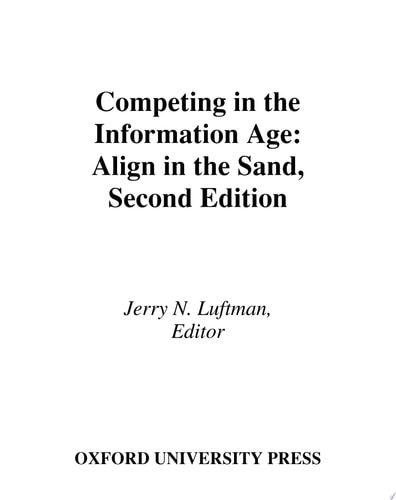
Most managers realize that information is among their company's most important assets. However, many don't know how to leverage their investments in information technology. Often, says Jerry N. Luftman, companies rush to acquire state-of-the-art systems without considering their long-term impact. For example, in the 1980s, retail banks invested heavily in ATMs--until ATMs ceased to be a competitive advantage and became merely another (and increasingly expensive) cost of doing business. Stemming from IBM's highly regarded Consulting Group, combining the expertise of consultants and leading academics, Competing in the Information Age shows managers how to avoid being blindsided by information technology. It outlines how to match information systems with business strategy to forge a strong competitive edge and bring powerful solutions to bear on real-world problems.The bottom line, Luftman contends, is that a firm must coordinate, or align, four elements: its business strategy, the strategy of its information systems, its organizational infrastructure, and its information technology infrastructure. To this end, he adds to his own expertise contributors who offer models, frameworks, and methods that can help companies in any industry discover their ideal strategic alignment. The contributors have a wide variety of backgrounds and approach information technology from a number of illuminating angles. They discuss how to distinguish between information systems that automate human skills and those that augment them; how to put together worldwide, flexible information structures that seamlessly connect people, products, and processes; and how to gauge the benefits of object-oriented programming and connected computer networks. A recurrent theme is the amount to which an executive should be versed in technology, with the caveat that technological jargon sometimes inhibits business opportunities. Other crucial topics include how inter- and intra-organizational systems (IOS) an
Menrva's Summary
THE THESIS
This book investigates the critical challenge of aligning information technology investments with overarching business strategies to maintain a sustainable competitive advantage. Jerry N. Luftman, drawing on his extensive background with IBM's Consulting Group and academic research, argues that companies frequently fail by treating technology as a standalone acquisition rather than an integrated component of organizational infrastructure. The text presents a comprehensive framework for coordinating business strategy, information systems, organizational structure, and IT infrastructure to ensure that technological deployments solve real-world problems rather than merely increasing operational costs.
THE SCOPE MAP
What You Will Find
- Strategic alignment models for integrating IT with business objectives.
- Methodologies for distinguishing between systems that automate versus those that augment human capabilities.
- Case studies and expert contributions from both industry consultants and academic researchers.
- Frameworks for developing flexible, worldwide information structures that connect people, products, and processes.
THE AUTHORITY PERSPECTIVE
Experts and business professionals frequently cite this work as a foundational text for understanding the intersection of IT management and corporate strategy. Readers often note the practical utility of the frameworks provided, which help bridge the communication gap between technical teams and executive leadership.
Page Count:
432
Publication Date:
1996-08-15
Publisher:
Oxford University Press
ISBN-10:
0195090160
ISBN-13:
9780195090161
Business
Strategy
Strategic Planning
Management
Information Technology
Competition
Organizational change
Community Tags
Similar Books