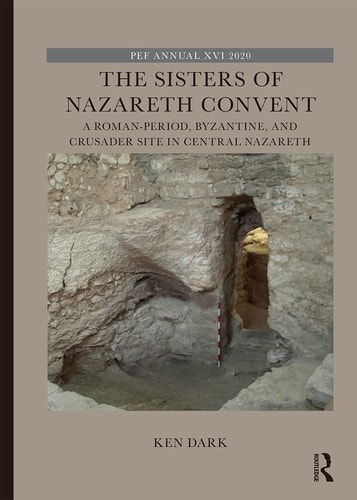
The Sisters of Nazareth Convent: A Roman-period, Byzantine, and Crusader Site in Central Nazareth
0
0
As an Amazon Associate and affiliate partner, Menrva Books earns from qualifying purchases. Learn more
Author Description
This book transforms archaeological knowledge of Nazareth by publishing over 80 years of archaeological work at the Sisters of Nazareth convent, including a detailed re-investigation in the early twenty-first century under the author's direction. Although one of the world's most famous places and of key importance to understanding early Christianity, Nazareth has attracted little archaeological attention. Following a chance discovery in the 1880s, the site was initially explored by the nuns of the convent themselves - one of the earliest examples of a major programme of excavations initiated and directed by women - and then for decades by Henri Senès, whose excavations (like those of the nuns) have remained almost entirely unpublished. Their work revealed a complex sequence, elucidated and dated by twenty-first century study, beginning with a partly rock-cut Early Roman-period domestic building, followed by Roman-period quarrying and burial, a well-preserved cave-church, and major surface-level Byzantine and Crusader churches. The interpretation and broader implications of each phase of activity are discussed in the context of recent studies of Roman-period, Byzantine, and later archaeology and contemporary archaeological theory, and their relationship to written accounts of Nazareth is also assessed. The Sisters of Nazareth Convent provides a crucial archaeological study for those wishing to understand the archaeology of Nazareth and its place in early Christianity and beyond.
Menrva's Summary
THE THESIS
The Sisters of Nazareth Convent presents a comprehensive archaeological analysis of a significant historical site in Nazareth. This book details over 80 years of archaeological work, including recent investigations, at the convent, a location of immense importance to early Christianity. It examines a complex sequence of occupation, beginning with an Early Roman-period domestic building, followed by Roman-period quarrying and burials, a cave-church, and later Byzantine and Crusader churches. The findings are discussed within the context of contemporary archaeological theory and historical accounts of Nazareth.
THE SCOPE MAP
- Detailed publication of archaeological findings from the Sisters of Nazareth convent spanning over 80 years.
- Re-investigation and analysis of the site conducted in the early twenty-first century.
- Examination of an Early Roman-period domestic building, Roman-period quarrying and burials.
- Study of a well-preserved cave-church and major surface-level Byzantine and Crusader churches.
- Interpretation of each phase of activity in relation to recent studies of Roman-period, Byzantine, and later archaeology.
- Discussion of contemporary archaeological theory and its application to the site.
- Assessment of the archaeological findings' relationship to written accounts of Nazareth.
THE AUTHORITY PERSPECTIVE
The book is presented as a crucial archaeological study for understanding Nazareth's history and its role in early Christianity. The author's direction of the twenty-first-century investigations lends authority to the re-interpretation of earlier findings. The work aims to elucidate the complex stratigraphy of the site, from Roman-period structures to later churches. Its significance lies in publishing previously inaccessible excavation data and integrating it with modern scholarship.
Page Count:
284
Publication Date:
2022-04-29
Publisher:
Taylor & Francis Group
ISBN-10:
0367542226
ISBN-13:
9780367542221
History
Non-Fiction
Christianity
Ancient History
Archaeology
Community Tags
Similar Books