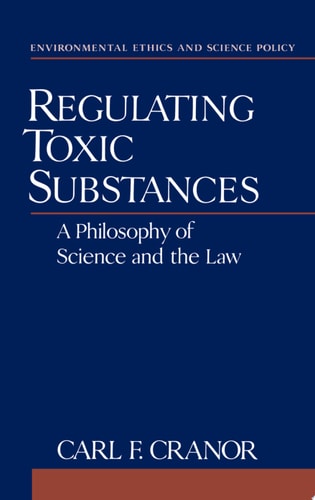
Regulating Toxic Substances: A Philosophy of Science and the Law
0
0
As an Amazon Associate and affiliate partner, Menrva Books earns from qualifying purchases. Learn more
Author Description
The proliferation of chemical substances in commerce poses scientific and philosophical problems. The scientific challenge is to develop data, methodologies, and techniques for identifying and assessing toxic substances before they cause harm to human beings and the environment. The philosophical problem is how much scientific information we should demand for this task consistent with other social goals we might have. In this book, Cranor utilizes material from ethics, philosophy of law, epidemiology, tort law, regulatory law, and risk assessment, to argue that the scientific evidential standards used in tort law and administrative law to control toxics ought to be evaluated with the purposes of the law in mind. Demanding too much for this purpose will slow the evaluation and lead to an excess of toxic substances left unidentified and unassessed, thus leaving the public at risk. Demanding too little may impose other costs. An appropriate balance between these social concerns must be found. Justice requires we use evidentiary standards more appropriate to the legal institutions in question and resist the temptation to demand the most intensive scientific evaluation of each substance subject to legal action.
Menrva's Summary
THE THESIS
This book investigates the tension between scientific evidentiary standards and the legal requirements for regulating toxic substances in commerce. Carl F. Cranor, a scholar in philosophy and law, examines the intersection of epidemiology, tort law, and regulatory policy to address how society should balance the demand for scientific certainty against the need to protect public health. He argues that current regulatory frameworks often impose excessive scientific burdens that delay the identification of harmful chemicals, thereby failing to meet the primary objectives of legal and environmental protection.
THE SCOPE MAP
What You Will Find
- An analysis of the philosophical and scientific challenges inherent in identifying toxic substances.
- A comparative study of evidentiary standards used in tort law versus administrative regulatory law.
- An examination of the ethical implications of risk assessment in public health policy.
- A proposed framework for balancing social goals with the practical limitations of scientific data collection.
THE AUTHORITY PERSPECTIVE
Experts in environmental law and philosophy of science recognize this work as a critical examination of the intersection between legal standards and scientific uncertainty. Readers frequently note the academic density of the prose, which provides a rigorous foundation for understanding the complexities of chemical regulation.
Page Count:
272
Publication Date:
1997-08-14
Publisher:
Oxford University Press
ISBN-10:
0195113780
ISBN-13:
9780195113785
Public Policy
Ethics
Toxicology
Law
Poisons
Law And Legislation