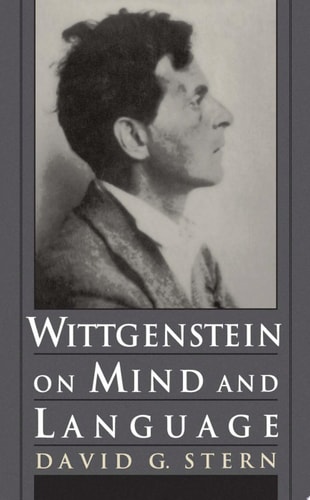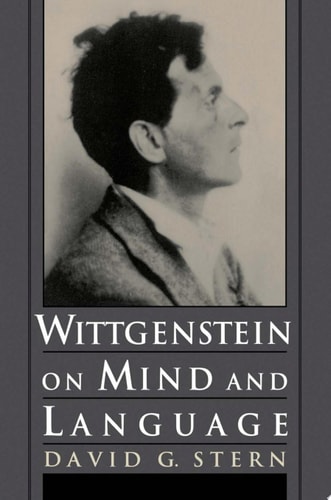
Wittgenstein on Mind and Language
0
0
As an Amazon Associate and affiliate partner, Menrva Books earns from qualifying purchases. Learn more
Author Description
Drawing on ten years of research on the unpublished Wittgenstein papers, Stern investigates what motivated Wittgenstein's philosophical writing and casts new light on the Tractatus and Philosophical Investigations. The book is an exposition of Wittgenstein's early conception of the nature of representation and how his later revision and criticism of that work led to a radically different way of looking at mind and language. It also explains how the unpublished manuscripts and typescripts were put together and why they often provide better evidence of the development of his ideas than can be found in his published writing. In doing so, the book traces the development of a number of central themes in Wittgenstein's philosophy, including his conception of philosophical method, the picture theory of meaning, the limits of language, the application of language to experience, his treatment of private language, and what he called the "flow of life." Arguing that Wittgenstein's views are often much more simple (and more radical) than we have been led to believe, Wittgenstein on Mind and Language provides an overview of the development of Wittgenstein's philosophy and brings to light aspects of his philosophy that have been almost universally neglected.
Menrva's Summary
THE THESIS
This book investigates the evolution of Ludwig Wittgenstein's philosophical framework by analyzing his unpublished manuscripts alongside his canonical published works. David G. Stern, a scholar of Wittgenstein's work, utilizes ten years of archival research to challenge traditional interpretations of the philosopher's development. By examining the transition from the early picture theory of meaning to the later, more radical critiques of mind and language, Stern argues that the unpublished papers offer a more accurate record of Wittgenstein's intellectual trajectory than the finalized texts alone.
THE SCOPE MAP
What You Will Find
- Analysis of Wittgenstein's unpublished manuscripts and typescripts as primary evidence.
- Examination of the shift from the 'Tractatus' to 'Philosophical Investigations'.
- Exploration of core themes including the picture theory of meaning, private language, and the 'flow of life'.
- A critical reassessment of Wittgenstein's philosophical methodology and its application to experience.
THE AUTHORITY PERSPECTIVE
Scholars and students of analytic philosophy frequently cite this work for its rigorous archival approach and its ability to clarify complex transitions in Wittgenstein's thought. Experts highlight this text as a necessary resource for those seeking to understand the relationship between Wittgenstein's private notes and his public philosophical output.
Page Count:
240
Publication Date:
1996-08-29
Publisher:
Oxford University Press
ISBN-10:
0195111478
ISBN-13:
9780195111477
Non-Fiction
Philosophy
Language
Intellect
Epistemology