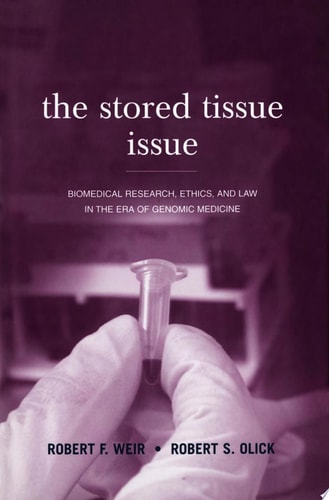
The Stored Tissue Issue: Biomedical Research, Ethics, and Law in the Era of Genomic Medicine
0
0
As an Amazon Associate and affiliate partner, Menrva Books earns from qualifying purchases. Learn more
Author Description
Genetics research with stored human tissues provides many benefits and holds much promise. Yet how this critical research is conducted sometimes raises serious ethical, legal, and social concerns, and it is difficult to balance the promise of biomedical research with our time-honored commitments to individual choice in such fundamental matters as control over personal health information and the disposition of our bodily tissues.Weir and Olick provide a thorough analysis of this critical phase in the era of genomic medicine. While strongly supportive of the biomedical research enterprise, they develop a critique of many common research practices with banked tissues, DNA, and genetic data. Noting numerous examples of beneficial human tissue research, they focus on problematic research practices, controversial cases, and federal and institutional policies that limit the informed choices of patients and research participants. The authors offer a series of recommendations intended to limit the risks of inadequate informed consent to research for individuals, families, and groups, and to strengthen the bonds of trust between the research enterprise and the public upon which biomedical progress depends.This book offers a wealth of information plus well-reasoned recommendations that will be of keen interest to geneticists, other biomedical scientists, research institutions, policymakers, students and others. It will serve as a clarion call to move beyond traditional policies and practices toward a richer understanding of partnership between patients and research participants and the biomedical research enterprise - a partnership for the benefit of all.
Menrva's Summary
THE THESIS
This book investigates the ethical, legal, and social tensions inherent in the use of stored human tissues for genomic research, questioning how to balance scientific progress with individual autonomy. Robert F. Weir and Robert S. Olick, both experts in bioethics and law, utilize a combination of case studies, policy analysis, and historical context to evaluate current research practices. They argue that while the biomedical research enterprise is vital, current institutional frameworks often fail to protect the informed choices of participants, necessitating a shift toward a more transparent partnership model.
THE SCOPE MAP
What You Will Find
- Analysis of federal and institutional policies governing tissue banking and genetic data.
- Examination of controversial case studies involving patient consent and bodily tissue disposition.
- A framework for improving informed consent processes to protect individuals and families.
- Recommendations for strengthening public trust in the biomedical research enterprise.
THE AUTHORITY PERSPECTIVE
Experts and academics in the fields of bioethics and law frequently cite this work as a foundational text for understanding the intersection of genomic medicine and patient rights. Readers often note the academic density of the prose, which provides a comprehensive and rigorous examination of the regulatory challenges facing modern genetic research.
Page Count:
366
Publication Date:
2004-05-20
Publisher:
Oxford University Press
ISBN-10:
0195123689
ISBN-13:
9780195123685
Science
Medicine
Biomedical Research
Genetics
Law
Ethics
Community Tags
Similar Books