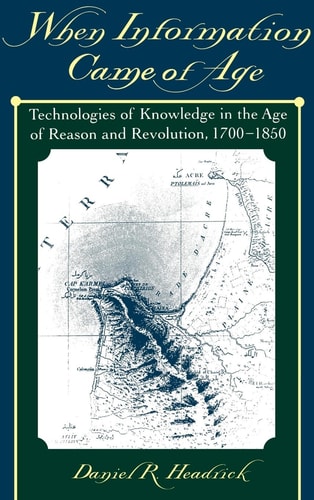
When Information Came of Age: Technologies of Knowledge in the Age of Reason and Revolution 1700-1850
0
0
As an Amazon Associate and affiliate partner, Menrva Books earns from qualifying purchases. Learn more
Author Description
Although the Information Age is often described as a new era, a cultural leap springing directly from the invention of modern computers, it is simply the latest step in a long cultural process. Its conceptual roots stretch back to the profound changes that occurred during the Age of Reason and Revolution. When Information Came of Age argues that the key to the present era lies in understanding the systems developed in the eighteenth and early nineteenth centuries to gather, store, transform, display, and communicate information.The book provides a concise and readable survey of the many conceptual developments between 1700 and 1850 and draws connections to leading technologies of today. It documents three breakthroughs in information systems that date to the period: the classification and nomenclature of Linnaeus, the chemical system devised by Lavoisier, and the metric system. It shows how eighteenth-century political arithmeticians and demographers pioneered statistics and graphs as a means for presenting data succinctly and visually. It describes the transformation of cartography from art to science as it incorporated new methods for determining longitude at sea and new data on the measure the arc of the meridian on land. Finally, it looks at the early steps in codifying and transmitting information, including the development of dictionaries, the invention of semaphore telegraphs and naval flag signaling, and the conceptual changes in the use and purpose of postal services.When Information Came of Age shows that like the roots of democracy and industrialization, the foundations of the Information Age were built in the eighteenth and early nineteenth century.
Menrva's Summary
THE THESIS
This book investigates the historical origins of the modern Information Age by tracing the development of information-processing systems during the eighteenth and early nineteenth centuries. Daniel R. Headrick, a historian of technology, utilizes a comparative framework to argue that contemporary digital systems are not isolated innovations but the culmination of long-standing cultural and scientific practices. By examining the period between 1700 and 1850, the author demonstrates how early efforts to classify, measure, and communicate data established the essential infrastructure for modern knowledge management.
THE SCOPE MAP
What You Will Find
- Analysis of scientific breakthroughs including Linnaean classification, Lavoisier’s chemical nomenclature, and the metric system.
- Examination of the evolution of cartography from artistic representation to precise scientific measurement.
- Documentation of early data visualization techniques, specifically the rise of statistics and graphical representation in political arithmetic.
- Overview of communication technologies such as semaphore telegraphs, naval signaling, and the institutionalization of postal services.
THE AUTHORITY PERSPECTIVE
Experts recognize this work as a clear, accessible synthesis that effectively bridges the gap between Enlightenment history and modern information studies. Readers frequently note the author's ability to connect historical administrative practices to contemporary technological frameworks without relying on overly dense academic jargon.
Page Count:
246
Publication Date:
2000-12-15
Publisher:
Oxford University Press
ISBN-10:
0195135970
ISBN-13:
9780195135978
Science
History
European History
Enlightenment
Communication
Information Science
Technology
Community Tags
Similar Books