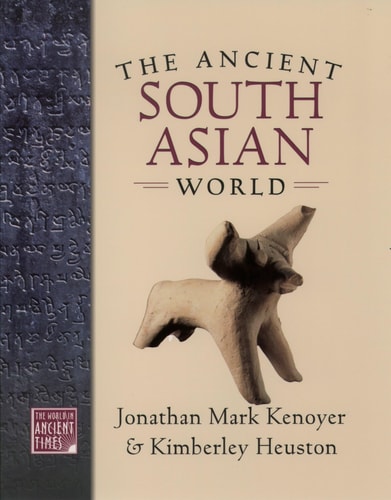
The Ancient South Asian World: The World in Ancient Times
0
0
As an Amazon Associate and affiliate partner, Menrva Books earns from qualifying purchases. Learn more
Author Description
A young archaeologist finds a primitive hand axe that is thought to be more than 400,000 years old. Engineers building a railroad discover that the gravel they're using is actually 5,000-year-old crumbling brick from the ancient Indus Valley civilization. An Englishman living in India is fascinated by the mysterious script on the ancient coins he collects and works feverishly to decode the long-lost language. These are a few of the clues to a fascinating history that you'll read about in The Ancient South Asian World.Jonathan Mark Kenoyer and Kimberley Heuston use ancient beads, terracotta pots, trash found in a sewer, and many other primary sources to trace the history of this diverse region. In these pages is the story of Emperor Chandragupta Maurya, who used the power of knowledge rather than physical force to rule his people-an unusual idea at the time. Ancient texts and an epic poem called the Ramayana explain the practices and beliefs of Brahmanism and how they evolved into Hinduism. Columns inscribed by Emperor Ashoka illustrate the spread of Buddhism throughout the South Asian world. The sacred epic called the Mahabharata helps explain the development of the caste system. From geography and weather to Hindu gods and intellectual traditions, the characters and stories in The Ancient South Asian World weave the history of this vibrant region.
Menrva's Summary
THE THESIS
How did the diverse civilizations of South Asia develop their complex social, religious, and political structures over thousands of years? Jonathan Mark Kenoyer, a prominent archaeologist, and Kimberley Heuston synthesize archaeological findings and ancient literary texts to reconstruct the development of the Indus Valley civilization and its successors. The authors argue that material culture, such as pottery and urban infrastructure, combined with foundational epics like the Ramayana, provides a comprehensive framework for understanding the region's historical evolution.
THE SCOPE MAP
What You Will Find
- Archaeological evidence including ancient beads, terracotta artifacts, and urban sewer systems.
- Analysis of the Indus Valley civilization and the subsequent Mauryan Empire.
- Examination of religious evolution from Brahmanism to Hinduism and the spread of Buddhism.
- Historical context provided by primary source texts such as the Mahabharata and the edicts of Emperor Ashoka.
THE AUTHORITY PERSPECTIVE
Experts recognize this work as an accessible entry point for students and general readers interested in the material culture of ancient South Asia. The text is praised for its ability to bridge the gap between complex archaeological data and the narrative history of the region's major empires.
Page Count:
172
Publication Date:
2005-06-23
Publisher:
Oxford University Press
ISBN-10:
0195174224
ISBN-13:
9780195174229
History
Non-Fiction
Asia history
Ancient History
Archaeology
Community Tags
Similar Books