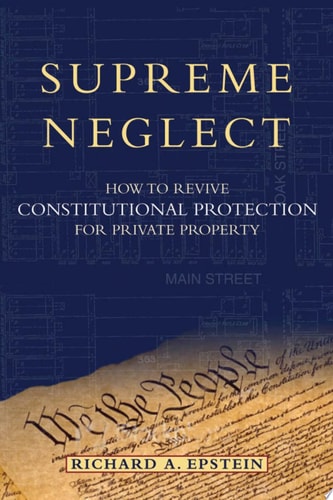
Supreme Neglect: How to Revive Constitutional Protection for Private Property
0
0
As an Amazon Associate and affiliate partner, Menrva Books earns from qualifying purchases. Learn more
Author Description
As far back as the Magna Carta in 1215, the right of private property was seen as a bulwark of the individual against the arbitrary power of the state. Indeed, common-law tradition holds that "property is the guardian of every other right." And yet, for most of the last seventy years, property rights had few staunch supporters in America.This latest addition to Oxford's Inalienable Rights series provides a succinct, pointed look at property rights in America--how they came to be, how they have evolved, and why they should once again be a mainstay of the law. Richard A. Epstein, the nation's preeminent authority on the subject, examines all aspects of private property--from real estate to air rights to intellectual property. He takes the reader from the strongly protective property rights advocated by the framers of the Constitution through to the weak property rights supported by Progressive and liberal politicians of the twentieth century and finally to our own time, which has seen a renewed appreciation of property rights in the aftermath of the Supreme Court's landmark Kelo v. New London decision in 2005. The author's own powerful defense of property rights threads through the narrative. Using both political theory and economic analysis, Epstein argues that above all that private property is a sound social institution, and not just an excuse for selfishness and greed. Only a system of private property lets people form and raise families, organize religious and other charitable organizations, and earn a living through honest labor.Supreme Neglect offers a compact, incisive look at this hotly contested constitutional right, championing property rights as an essential social institution.
Menrva's Summary
THE THESIS
How can the American legal system restore the constitutional protections for private property that have eroded over the last seventy years? Richard A. Epstein, a prominent legal scholar, utilizes a combination of historical analysis, political theory, and economic reasoning to argue that private property is a foundational social institution rather than a mere instrument of individual greed. He traces the shift from the robust protections envisioned by the Framers to the weakened state of property rights under twentieth-century Progressive policies, ultimately advocating for a return to stronger judicial oversight.
THE SCOPE MAP
What You Will Find
- Historical evolution of property rights from the Magna Carta to the 2005 Kelo v. New London decision.
- Economic analysis of property as a mechanism for social organization and family stability.
- Comparative study of constitutional interpretations regarding real estate, air rights, and intellectual property.
- Critique of Progressive and liberal legal frameworks that have diminished property protections.
THE AUTHORITY PERSPECTIVE
Legal scholars and practitioners recognize this work as a definitive argument for the protection of property rights within the American constitutional framework. Readers frequently note the clarity of Epstein's prose, which makes complex legal and economic theories accessible to a broader audience interested in constitutional history.
Page Count:
208
Publication Date:
2008-03-12
Publisher:
Oxford University Press
ISBN-10:
0195304608
ISBN-13:
9780195304602
Economics
History
United States
Law
Land Use
Eminent Domain
Constitutional Law