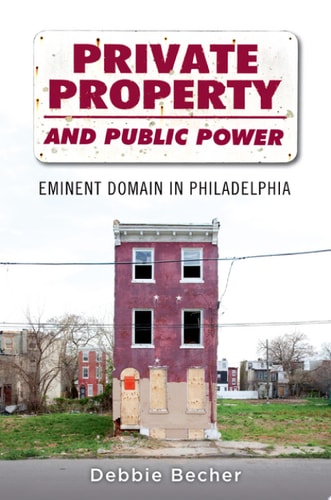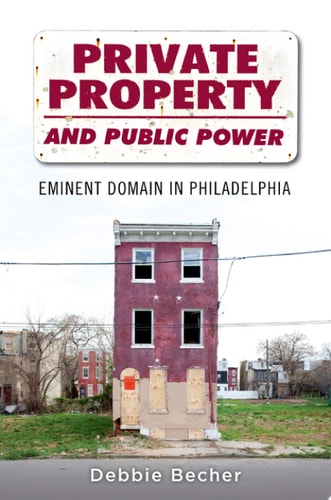
Private Property and Public Power: Eminent Domain in Philadelphia
0
0
As an Amazon Associate and affiliate partner, Menrva Books earns from qualifying purchases. Learn more
Author Description
News media reports on eminent domain often highlight outrage and heated protest. But these accounts, Debbie Becher finds, obscure a much more complex reality of how Americans understand property. Private Property and Public Power presents the first comprehensive study of a city's acquisitions, exploring how and why Philadelphia took properties between 1992 and 2007 for private redevelopment. Becher uses original data-collected from city offices and interviews with over a hundred residents, business owners, community leaders, government representatives, attorneys, and appraisers-to explore how eminent domain really works. Surprisingly, the city took over 4,000 private properties, and these takings rarely provoked opposition. When conflicts did arise, community residents, businesses, and politicians all appealed to a shared notion of investment to justify their arguments about policy. It is this social conception of property as an investment of value, committed over time, that government is responsible for protecting. Becher's findings stand in stark contrast to the views of libertarian and left-leaning activists and academics, but recognizing property as investment, she argues, may offer a solid foundation for more progressive urban policies.
Menrva's Summary
THE THESIS
How does the social perception of property as a long-term investment influence the implementation and public acceptance of eminent domain in urban environments? Debbie Becher, a sociologist, examines the mechanisms of property acquisition in Philadelphia between 1992 and 2007. By synthesizing original city data with extensive qualitative interviews, she argues that property is viewed by stakeholders not merely as a legal right, but as a social investment of value that the government is expected to protect. This framework challenges conventional political narratives that frame eminent domain solely as a conflict between state power and individual rights.
THE SCOPE MAP
What You Will Find
- A comprehensive analysis of over 4,000 property acquisitions in Philadelphia from 1992 to 2007.
- Qualitative data derived from interviews with residents, business owners, government officials, and legal professionals.
- A theoretical framework defining property as a social investment of value committed over time.
- Comparative analysis of how different political factions utilize the concept of investment to justify urban development policies.
THE AUTHORITY PERSPECTIVE
Experts identify this work as a significant contribution to urban sociology and legal studies for its empirical approach to a contentious political issue. Readers frequently note the academic rigor of the text, which provides a nuanced alternative to polarized debates surrounding property rights.
Page Count:
360
Publication Date:
2014-09-10
Publisher:
Oxford University Press
ISBN-10:
0199322554
ISBN-13:
9780199322558
History
United States
Eminent Domain
Land Use
Public Policy
urban planning
Law
Urban renewal
Sociology