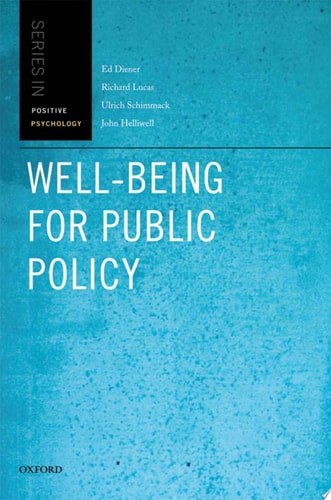
Well-Being for Public Policy
0
0
As an Amazon Associate and affiliate partner, Menrva Books earns from qualifying purchases. Learn more
Author Description
In this volume, the authors explain the reasons why subjective indicators of well-being are needed. They describe how these indicators can offer useful input and provide examples of policy uses of well-being measures. The book then delves into objections to the use of subjective well-being indicators for policy purposes and discusses why these objections are not warranted. Finally, the book contains answers pertaining to the measures that are currently in use and describes the types of measures that are most likely to be valuable in the policy domain.At the most ambitious, even audacious, level, Well-Being for Public Policy has the potential of transforming society by making people and policy more concerned about well-being, and less concerned about economics and income. The existence of national measures of well-being would draw more interest to the rewarding and problem areas of life, and serve to give a broader focus to societal decisions. National accounts of well-being could reorient societies so that social values, the environment, enjoyable work, and physical and emotional health are given prominence along with economic development. This book is an invaluable treatise on current understanding of the complex relationship between well-being and public policy-- it will be of great interest to researchers in the fields of psychology and economics.
Menrva's Summary
THE THESIS
This book investigates the necessity and practical application of subjective well-being indicators as a primary metric for evaluating and shaping public policy. The authors, a team of distinguished researchers in psychology and economics, argue that traditional economic indicators like income are insufficient for measuring societal progress. By presenting a framework for national accounts of well-being, they contend that policy decisions should prioritize social values, environmental health, and emotional stability alongside economic development.
THE SCOPE MAP
What You Will Find
- Analysis of subjective well-being indicators versus traditional economic metrics.
- Evaluation of common objections to using psychological data in government policy.
- Practical examples of how well-being measures are currently utilized in policy domains.
- Methodological guidance on selecting the most valuable measures for societal assessment.
THE AUTHORITY PERSPECTIVE
Experts recognize this work as a foundational text for those interested in the intersection of behavioral science and governance. Readers frequently note the academic density of the prose, which serves as a rigorous resource for researchers and policy analysts alike.
Page Count:
256
Publication Date:
2009-04-17
Publisher:
Oxford University Press
ISBN-10:
0195334078
ISBN-13:
9780195334074
Economics
Psychology
Public Policy
Quality of Life
Social Science
Sociology
Community Tags
Similar Books