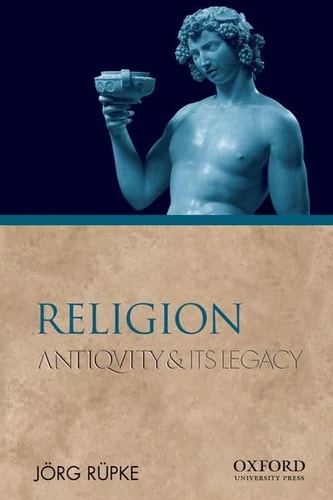
Religion: Antiquity and Its Legacy
0
0
As an Amazon Associate and affiliate partner, Menrva Books earns from qualifying purchases. Learn more
Author Description
What is a religion? What triggered the spontaneous development of distinct religions throughout the ancient world? How do religions evoke the ultimate realities they claim to address? Such questions are as evergreen as belief itself. The Hellenistic and Roman worlds were a fertile seedbed of the monotheistic faiths that dominate today's western image of religion, as well as many global conflicts. In this concise and elegant overview, Jörg Rüpke addresses the similarities and differences of religions in antiquity, tracing their sometimes complex lineage into modern systems of belief. Greek and Roman religion is discussed not in isolation, but in the broader context of western Asia and Egypt. The author also addresses developments relating to early Islam on the south-eastern margins of the Byzantine Empire.Examining such topics as the functions of priests and religious functionaries; religious individualism; the relationship between religion and political identity; the acceptance of the pagan Julian calendar by Christians; and contrasting ancient and modern understandings of divination, Rüpke shows that study of pre-modern culture enables us more daringly to explore the contemporary religious world.
Menrva's Summary
THE THESIS
This work investigates the fundamental nature of religion in antiquity and its enduring influence on the development of modern belief systems. Jörg Rüpke, a scholar of Roman religion, utilizes historical evidence from the Hellenistic and Roman worlds to analyze how ancient societies constructed religious identities. He argues that understanding the complex, interconnected religious landscape of pre-modern cultures provides essential context for interpreting contemporary religious conflicts and structures.
THE SCOPE MAP
What You Will Find
- Comparative analysis of religious practices across Greece, Rome, western Asia, and Egypt.
- Examination of the role and function of ancient priests and religious officials.
- Exploration of religious individualism and the intersection of faith with political identity.
- Historical inquiry into the transition from pagan calendars to Christian adoption.
THE AUTHORITY PERSPECTIVE
Scholars and students of classical history frequently cite this text for its ability to synthesize complex religious developments into a concise, accessible framework. Experts highlight the author's broad geographical approach as a significant contribution to moving beyond isolated studies of Greek and Roman traditions.
Page Count:
240
Publication Date:
2013-11-01
Publisher:
Oxford University Press
ISBN-10:
0195380762
ISBN-13:
9780195380767
History
Religion
Theology
Ancient History
Rome religion
Community Tags
Similar Books