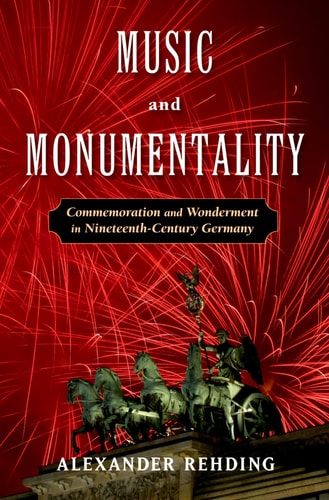
Music and Monumentality: Commemoration and Wonderment in Nineteenth Century Germany
0
0
As an Amazon Associate and affiliate partner, Menrva Books earns from qualifying purchases. Learn more
Author Description
A few weeks after the reunification of Germany, Leonard Bernstein raised his baton above the ruins of the Berlin Wall and conducted a special arrangement of Beethoven's Ninth Symphony. The central statement of the work, that "all men will be brothers," captured the sentiment of those who saw a brighter future for the newly reunited nation. This now-iconic performance is a palpable example of "musical monumentality" - a significant concept which underlies our cultural and ideological understanding of Western art music since the nineteenth-century. Although the concept was first raised in the earliest years of musicological study in the 1930s, a satisfying exploration of the "monumental" in music has not yet been made. Alexander Rehding, one of the brightest young stars in the field, takes on the task in Music and Monumentality, an elegant, thorough treatment that will serve as a foundation for all future discussion in this area.Rehding sets his focus on the main players of the period within the Austro-German repertoire -Beethoven, Liszt, Wagner, Brahms, Bruckner and Mahler- as he unpacks a two-fold definition of "musical monumentality." In the conventional sense, monumentality is a stylistic property often described as 'grand,' 'uplifting,' and 'sublime' and rife with overpowering brass chorales, sparkling string tremolos, triumphant fanfares, and glorious thematic returns. Yet Rehding sees the monumental in music performing a cultural task as well: it is employed in the service of establishing national identity. Through a clear theoretical lens, Rehding examines how grand sound effects are strategically employed with the view to overwhelming audiences, how supposedly immutable musical halls of fame change over time, how challenging musical works are domesticated, how the highest cultural achievements are presented in immediately consumable form-in a word, how German music emerges as a unified cultural and musical brand.
Menrva's Summary
THE THESIS
This book investigates the concept of musical monumentality in nineteenth-century German music, questioning how grand aesthetic styles intersect with the construction of national identity. Alexander Rehding, a scholar in the field of musicology, utilizes a theoretical framework to analyze the works of major Austro-German composers. By examining the intersection of stylistic grandeur and cultural utility, he argues that musical monumentality functions as a deliberate tool for shaping collective identity and institutionalizing musical canons.
THE SCOPE MAP
What You Will Find
- Analysis of major Austro-German composers including Beethoven, Liszt, Wagner, Brahms, Bruckner, and Mahler.
- A dual-definition framework of monumentality as both a stylistic property and a cultural instrument.
- Examination of how musical works are domesticated and presented for public consumption.
- Investigation into the strategic use of sound effects to influence audience perception and national branding.
THE AUTHORITY PERSPECTIVE
Experts recognize this work as a foundational text that fills a significant gap in musicological literature regarding the monumental in music. Readers frequently note the academic rigor and theoretical clarity Rehding brings to his analysis of nineteenth-century repertoire.
Page Count:
320
Publication Date:
2009-08-19
Publisher:
Oxford University Press
ISBN-10:
0195385381
ISBN-13:
9780195385380
History
Philosophy
Music
Modern History
Humanities
German history
Music Technology
Musicology
Music History
Music German
Community Tags
Similar Books