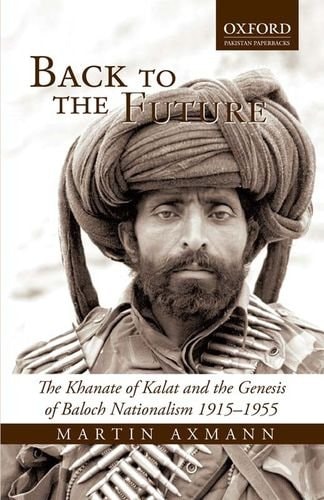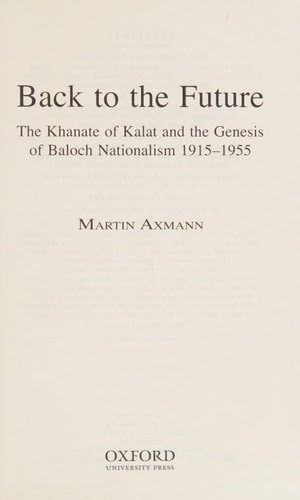
Back to the Future: The Khanate of Kalat and the Genesis of Baluch Nationalism 1915-1955
0
0
As an Amazon Associate and affiliate partner, Menrva Books earns from qualifying purchases. Learn more
Author Description
Back to the Future investigates the genesis of Baloch nationalism during the first half of the twentieth century, analyzes the emergence of a Baloch national movement, and sets it in relation to the rise of an Indian and Muslim Indian (Pakistan) national movement in British India during that time. The study portrays the decline and disintegration of the Baloch khanate of Kalat during the last decades of British rule, analyzes Kalat's lack of integration but increasing attachment to British Indian affairs, and summarizes the colonial legacy of Balochistan in respect of political, administrative, and constitutional development. It investigates the emergence of a royalist movement around the figure of the khan of Kalat, and discusses his attempt to turn back time and revert to Balochistan's pre-colonial status. The book also probes into the coincident rise of a Baloch nationalist movement, and analyzes the political and cultural framework of an emerging Baloch national identity. It traces the political demands of Baloch nationalist pioneers, and looks for interrelations with the Muslim nationalist and the Baloch royalist movements. Back to the Future ascertains the emergence of a Baloch national movement as the outcome of the historical and political circumstances during the British withdrawal from India, and portrays the evolution of Baloch national identity as a reaction to the territorial, political, and cultural inclusion on the side of the All India Muslim League and the Pakistan movement.
Menrva's Summary
THE THESIS
This study investigates the historical origins of Baloch nationalism and the disintegration of the Khanate of Kalat during the transition from British colonial rule to the formation of Pakistan. Martin Axmann, a political scientist specializing in ethno-nationalist movements in the Indian subcontinent, utilizes historical records and political analysis to examine how the Baloch national identity emerged as a reactive force against the territorial and political integration efforts of the All India Muslim League. The work provides a framework for understanding the complex interplay between royalist aspirations, colonial administrative legacies, and the rise of subnationalist movements in the post-colonial era.
THE SCOPE MAP
What You Will Find
- Analysis of the political, administrative, and constitutional development of Balochistan between 1915 and 1955.
- Examination of the royalist movement centered on the Khan of Kalat and his attempts to restore pre-colonial status.
- Investigation into the interrelations between Baloch nationalism, the Pakistan movement, and British Indian affairs.
- Evaluation of the cultural and political frameworks that facilitated the emergence of a distinct Baloch national identity.
THE AUTHORITY PERSPECTIVE
Scholars and regional analysts recognize this text as a specialized contribution to the study of subnationalism within the Indian subcontinent. Readers frequently note the academic density of the prose and the author's rigorous application of political science methodologies to historical archival data.
Page Count:
336
Publication Date:
2008-01-01
Publisher:
Oxford University Press
ISBN-10:
019547645X
ISBN-13:
9780195476453
History
Nationalism asia
Colonialism
Nationalism
Pakistan
Community Tags
Similar Books