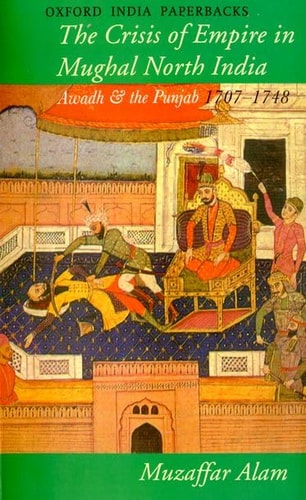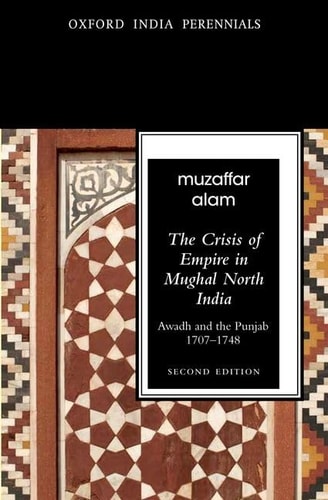
The Crisis of Empire in Mughal North India: Awadh and the Punjab 1707-1748
0
0
As an Amazon Associate and affiliate partner, Menrva Books earns from qualifying purchases. Learn more
Author Description
The collapse of the Mughal empire has often been characterized as a period of political fragmentation, social unrest, and economic decay. Contrasting two regions in north India--Awadh and the Punjab--Muzaffar Alam contends that even as the empire declined, there emerged a new, regionally-based political order, maintained and controlled by former Mughal rulers. From agrarian uprisings to the jagiardari system, the Sikhs to the Zamindars, this book presents a bold new interpretation of an important transition in Indian government.
Menrva's Summary
THE THESIS
This work investigates the nature of the Mughal Empire's decline by challenging the traditional narrative of total systemic collapse in favor of a regional political transformation. Muzaffar Alam, a scholar of Indian history, utilizes archival records and administrative data to analyze the shifting power dynamics in Awadh and the Punjab between 1707 and 1748. He argues that the transition was not merely one of decay, but a reconfiguration of authority where local elites and former Mughal officials established new, stable regional orders that sustained governance despite the weakening of the central imperial core.
THE SCOPE MAP
What You Will Find
- Comparative analysis of political and economic structures in Awadh and the Punjab.
- Examination of the jagirdari system and its impact on agrarian stability.
- Assessment of the roles played by Zamindars and the Sikh community in regional power shifts.
- Evidence derived from primary Mughal administrative documents and regional records.
THE AUTHORITY PERSPECTIVE
Historians and South Asian scholars frequently cite this work as a foundational text for understanding the complexities of eighteenth-century Indian political history. Readers often note the academic density of the prose, which provides a rigorous challenge to long-standing historiographical assumptions about the Mughal decline.
Page Count:
384
Publication Date:
1988-03-03
Publisher:
Oxford University Press
ISBN-10:
0195618920
ISBN-13:
9780195618921
History
India
Asian History
Punjab India
Economic History
Mughal Empire
India - History
Political History