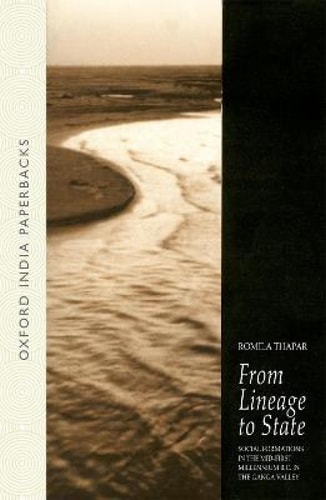
From Lineage to State
0
0
As an Amazon Associate and affiliate partner, Menrva Books earns from qualifying purchases. Learn more
Author Description
This is an attempt to define Indian society in the crucial period of the mid-first millennium BC and in the seminal area of the Ganges Valley. It examines the major change from a lineage-based society to the establishment of state systems, and takes into account the emergence of a peasant economy and the process of urbanization.
Menrva's Summary
THE THESIS
This work investigates the structural transformation of Indian society during the mid-first millennium BC, specifically focusing on the transition from lineage-based social organizations to centralized state systems. Romila Thapar, a preeminent historian of ancient India, utilizes archaeological data, textual analysis, and socio-economic theory to map the evolution of the Ganges Valley. She argues that the emergence of a peasant economy and the subsequent process of urbanization were the primary catalysts for this political and social shift.
THE SCOPE MAP
What You Will Find
- Analysis of the mid-first millennium BC in the Ganges Valley
- Examination of the transition from lineage-based social structures to state systems
- Investigation into the emergence of peasant economies
- Discussion on the historical processes of urbanization in ancient India
THE AUTHORITY PERSPECTIVE
Experts recognize this text as a foundational study for understanding the socio-political evolution of ancient India. Scholars frequently cite Thapar's work for its rigorous methodology and its ability to synthesize complex archaeological and historical data into a coherent narrative of state formation.
Page Count:
188
Publication Date:
1993-11-01
Publisher:
Oxford University Press
ISBN-10:
0195626753
ISBN-13:
9780195626759
Economics
History
Sociology
India
Community Tags
Similar Books